- Google's AI Local Pack surfaces roughly 32% as many unique businesses as the traditional 3-pack — winning it means fewer competitors, but different signals.
- 45% of consumers now use AI tools for local business recommendations (BrightLocal, Sep 2026), and AI local packs appear on approximately 68% of local business queries.
- Review velocity (cadence of new reviews) now outweighs total review count as a ranking signal — steady weekly reviews beat a burst of 50 old ones.
- Behavioral and engagement signals (GBP posts, photos, calls) plus AI search signals entered the local ranking factors list for the first time in 2026.
- Your own website's answer-first content, local schema, and neighborhood mentions are cited by AI engines alongside your GBP — the page is now part of the local pack.
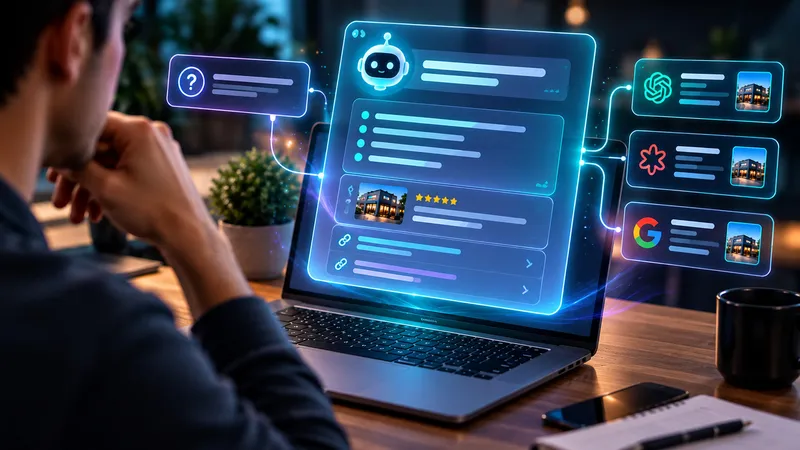
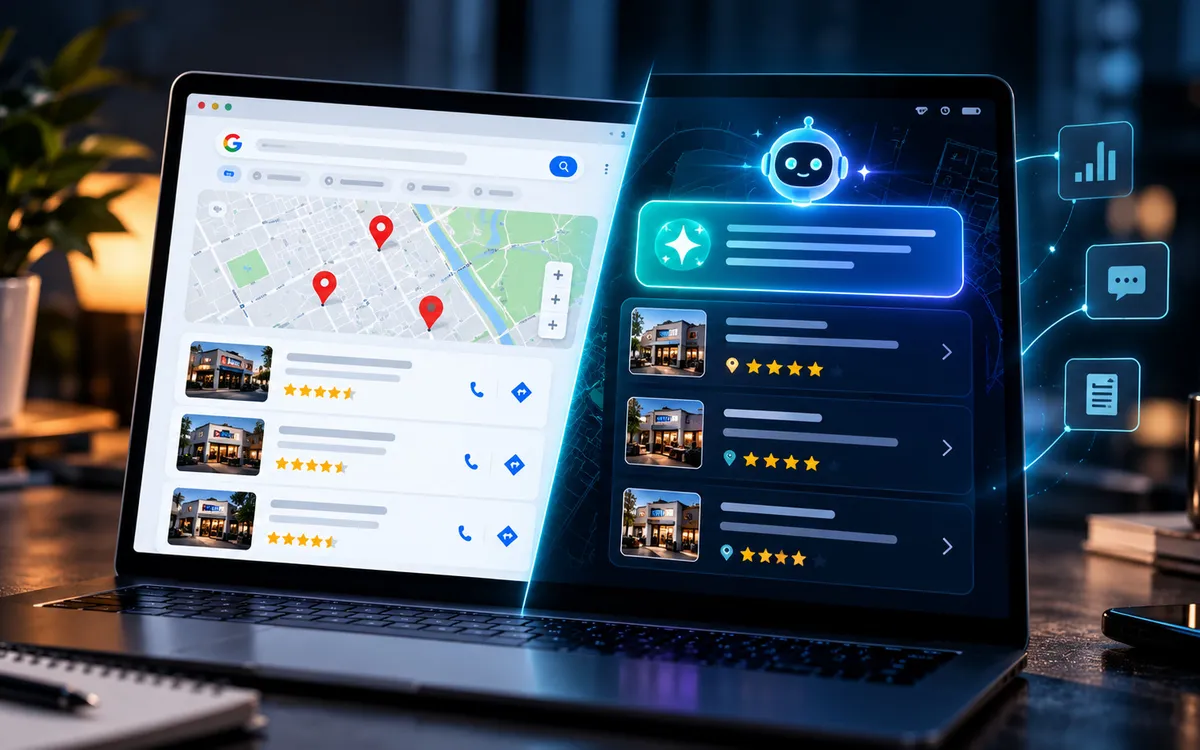
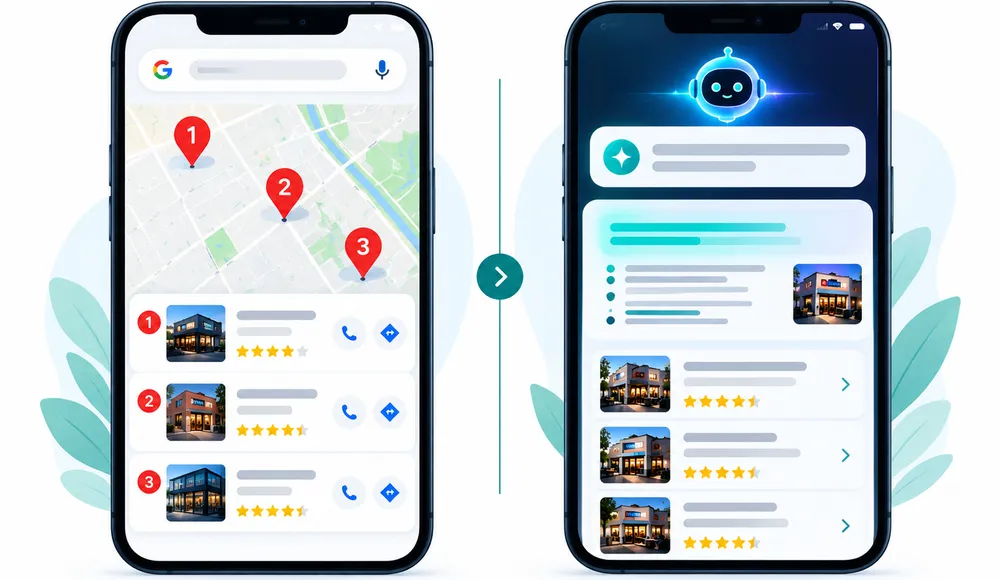
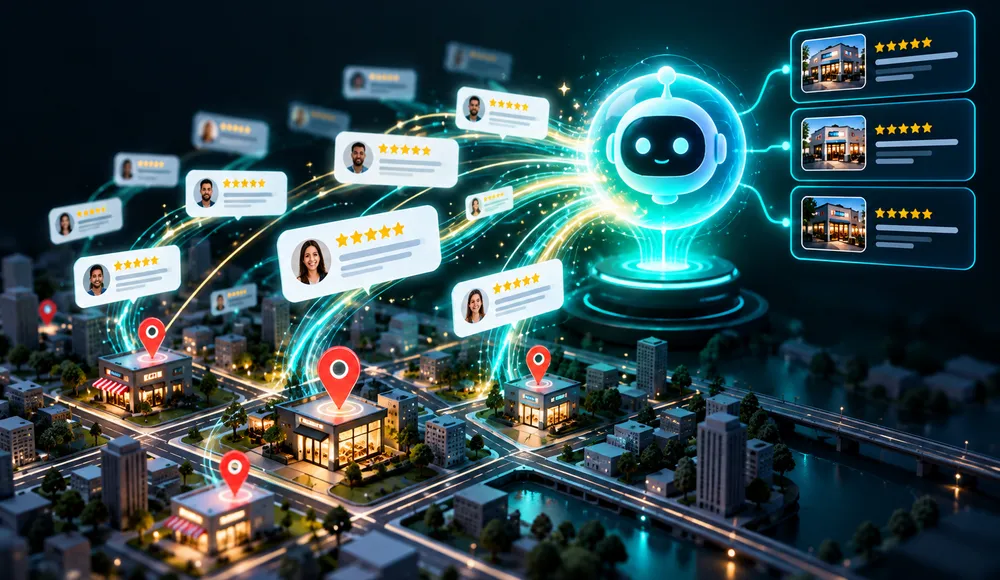
Google's local results are splitting in two. The classic three-pack — map, pins, stars — still appears on most local queries. But now a second surface is taking share: the AI Local Pack, where Gemini-powered overviews summarize local businesses, pull in reviews, and recommend options in conversational prose. Whitespark's May 2026 tracking found AI local packs on roughly 68% of local business queries. Sterling Sky's data shows they surface about 32% as many unique businesses as the traditional pack.
That means two things for a service business. First, the competition for AI Local Pack placement is thinner — fewer businesses make the cut. Second, the signals that decide who makes that cut are not identical to the classic map pack. A strong Google Business Profile is still necessary. It is no longer sufficient.
This guide breaks down what changed, the nine signals that now decide AI Local Pack placement, and the on-page content work that makes your website citable by AI engines — not just crawlers. It is the same playbook we run for our own Hisar office GBP and for clients across five countries.
| Signal | Why it decides | How to improve it |
|---|---|---|
| Primary category | Weighted above name and proximity in the survey | One primary that matches customer language |
| Profile completeness | An incomplete profile cannot be matched to a query | Every field filled, including services |
| Review volume | Volume and recency both weigh | A steady weekly ask, not a campaign |
| Review recency | Recent reviews signal an active business | Reply to every review |
| NAP consistency | Cross-checked against directories and social | One string, identical everywhere |
| Location pages | A page for each area served | One page per location, with local specifics |
| Local answers | What an AI is asked about a local business | Direct answers on the location page |
| Photos and posts | Freshness and engagement | Real photos on a schedule |
| Hours accuracy | Being open when searched | Updated for festivals and holidays |
What Is the AI Local Pack (and Why It Matters Now)
The AI Local Pack is Google's AI-generated summary of local businesses that appears above or beside traditional local results. Instead of a map with three pins, you get a prose answer: "For reliable web development in Hisar, businesses frequently mention AnyPlace for fixed-scope delivery and weekly demos, with a 4.9-star rating across Google reviews." The summary synthesizes GBP data, website content, reviews, and third-party mentions into a single answer block.
It matters because of scale and behavior. AI Mode reached roughly one billion monthly users in 2026. BrightLocal's September 2026 study of 200,875 local AI prompts found 45% of consumers now use AI tools for local business recommendations — a number that did not exist in 2024. When a homeowner in Denver asks ChatGPT "who should I hire for a Shopify rebuild," the answer is no longer ten blue links. It is one synthesized recommendation list. Being on that list is the new page-one ranking.
The practical implication: your local SEO strategy now has two targets. The classic map pack (driven primarily by GBP signals and proximity) and the AI Local Pack (driven by GBP signals plus citation-ready content on your own domain). You optimize for both with one integrated effort — but you need to know which levers pull which surface.
How AI Local Pack Ranking Differs From the Traditional Local Pack
The traditional local pack is driven by a well-documented signal set: primary GBP category, proximity, review quantity and rating, on-page relevance, and behavioral signals like calls and direction requests. Whitespark's 2026 Local Search Ranking Factors confirmed primary GBP category remains the number-one factor for the classic pack.
The AI Local Pack layers additional signals on top. Sterling Sky's State of Local SEO 2026 found that AI search signals entered the ranking factors for the first time — meaning how your brand is cited across AI platforms (ChatGPT, Perplexity, AI Overviews) now feeds back into local placement. Social signals also debuted as a factor. And behavioral engagement — GBP post cadence, photo uploads, Q&A activity — carries more weight than static completeness.
The biggest structural difference: the AI Local Pack reads your website. The classic map pack mostly does not. When Gemini synthesizes a local answer, it pulls from your site's content — your service pages, your city pages, your FAQs, your case studies. This is why a business with a mediocre website but a perfect GBP can still win the map pack while losing the AI pack. Your website is now a local ranking asset, not just a conversion surface.
The Nine Signals That Decide AI Local Pack Placement
Based on the 2026 Whitespark and Sterling Sky data, plus our own testing across client accounts, these are the signals that most consistently predict AI Local Pack inclusion:
One, primary GBP category — still the strongest single factor. Choose the category your highest-value customers would search, not a broad umbrella. Two, review velocity — the cadence of new reviews matters more than the total count. A business with 80 reviews gaining four per month outranks one with 300 reviews and none this year. Three, on-page quality — your website's content depth, answer-first structure, and local relevance. Four, behavioral engagement — GBP posts, photo uploads, Q&A, messages, calls. Five, social signals — brand mentions and engagement on social platforms, newly weighted in 2026. Six, AI search signals — how frequently your brand is cited by ChatGPT, Perplexity, and AI Overviews for local queries. Seven, proximity — still a factor but less dominant in AI summaries than in the classic pack. Eight, entity consistency — NAP (name, address, phone) matching across your GBP, website, and major directories. Nine, content depth — neighborhood mentions, local case studies, and service-area specificity on your website.
No single signal wins alone. But the ones most businesses neglect — review velocity, AI search signals, and on-page content depth — are the ones that increasingly separate AI pack winners from losers.
What the 200K+ Prompt Study Reveals About Consumer Behavior
BrightLocal's September 2026 study analyzed 200,875 local AI prompts and 1.9 million citations. Three findings stand out for service businesses.
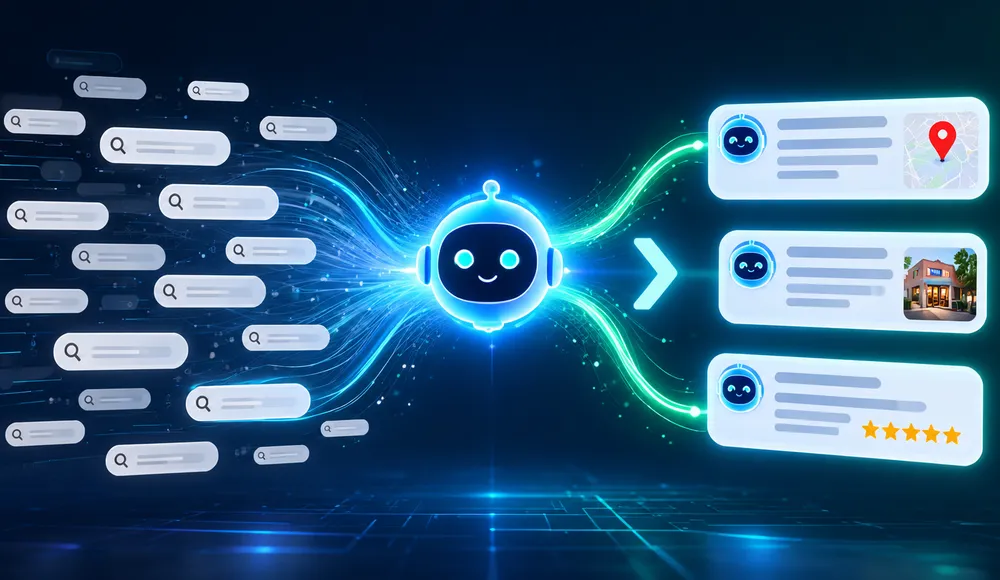
First, AI local prompts are more conversational and longer than traditional searches. Instead of "plumber near me," users ask "who's a reliable emergency plumber in Austin who works weekends and does free estimates." This longer-form intent means your content needs to answer specific, multi-clause questions — not just rank for a two-word keyword.
Second, citations skew toward businesses with deep, structured content. The AI doesn't just read your GBP — it reads your website, your blog, your FAQ pages, and third-party reviews. A business with a comprehensive city page, service-specific landing pages, and a steady stream of local content gets cited more than one with only a GBP listing.
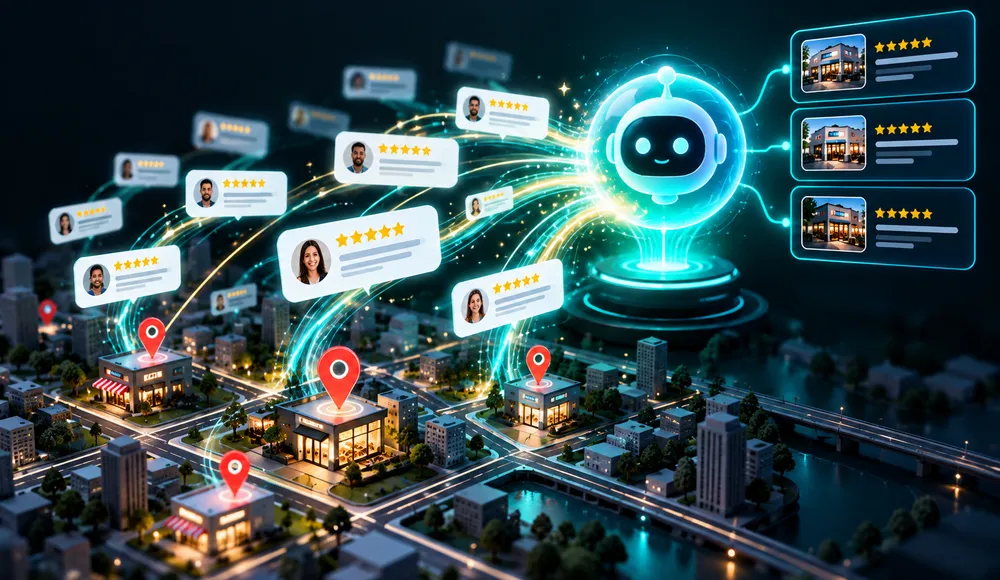
Third, review sentiment and specificity matter more than star rating alone. AI engines quote specific review text — "praised for fixed-scope pricing and weekly demos" — not just "4.9 stars." Encouraging detailed, service-specific reviews gives the AI more to quote.
How to Optimize Your GBP for the AI Local Pack
Your Google Business Profile remains the foundation. Here is the 2026 optimization sequence that moves both the classic and AI packs.
Primary category: audit it quarterly. If you offer multiple services, pick the one that maps to your highest-value query. A software company should be "Software Company" not "IT Consultant" if custom development is the revenue driver. Secondary categories: add up to four relevant ones, but know that primary dominates.
Review velocity system: set a weekly target — two to four new reviews per week for a single-location business. Use a review request flow after every completed engagement. Respond to every review within 48 hours with a response that naturally references the service and city ("Glad the ecommerce rebuild for your Charlotte store is performing well"). That response text is indexed.
GBP posts: publish weekly. Short updates, project completions, offers. Posts are underused and carry behavioral weight. Photos: upload two to three per week — job sites, team, completed projects. Descriptive filenames help ("hisar-web-development-office.jpg" not "IMG_4821.jpg").
Q&A: seed your own questions and answers before customers ask. Pre-answer the top ten questions your sales team hears. These Q&A pairs get pulled into AI summaries. Attributes: fill every applicable one — accessibility, online appointments, service areas.
On-Page Signals AI Engines Look For on Your Website
This is where most local businesses leave the AI Local Pack on the table. Your GBP is optimized, but your website is invisible to AI crawlers.
Answer capsules: every key page — service pages, city pages, cost pages — needs a 40–60 word direct answer right after the H1 or first H2. This is the passage AI engines extract and quote. If the answer is buried in paragraph three behind a tab, it will not be cited.
Local schema: implement LocalBusiness (or Service with serviceArea for remote-only markets) with accurate NAP, geo coordinates, opening hours, and sameAs links. This removes ambiguity for AI parsers. FAQPage schema on any page with FAQs — the HowTo and FAQPage types correlate with higher citation rates in multiple 2026 studies.
Neighborhood mentions: name the specific neighborhoods, suburbs, and areas you serve — in body copy, not just a hidden list. When someone asks ChatGPT "web developer near Uptown Denver," the AI looks for pages that mention Uptown Denver explicitly.
Review embeds: display your Google reviews on your website with structured markup. This gives AI engines review content without leaving your domain. Case studies with local proof — "a billing platform for a Hisar textile SME" — are among the most-cited content types by AI engines because they contain unique, first-hand data.
Content Strategy: The Pages AI Local Pack Cites
AI engines do not cite homepages. They cite specific, answer-rich pages that match the query. Here is the page architecture that wins AI Local Pack citations for a multi-location service business.
City hub pages: one comprehensive page per service area covering services, neighborhoods, local industries, pricing, and FAQs. These are your primary local citation assets. Each one needs an answer capsule ("AnyPlace serves [city] with fixed-scope software development, web builds, and digital marketing from a senior-led team, with daily overlap to your working hours"), local schema, and neighborhood-specific content.
Service pages: your main service pages need local relevance signals — mention the markets you serve, link to city pages, include local case studies. When someone asks "best CRM development for a healthcare clinic," the AI reads your CRM service page, not your city page.
Cost pages: local pricing pages ("software development cost in [city/country]") are highly citable because they answer a specific, common question with concrete numbers. AI engines prefer pages with named figures over vague ranges.
Case studies: first-hand delivery write-ups with real numbers are the single most-cited content type by AI engines. They cannot be regenerated by a language model because the data is proprietary. Publish one per quarter minimum.
FAQ blocks: every page should have four to six FAQs with 40–80 word answers. These are extracted as standalone passages and cited directly.
Measuring AI Local Pack Visibility
Traditional rank trackers do not capture AI Local Pack placement. You need a different measurement approach.
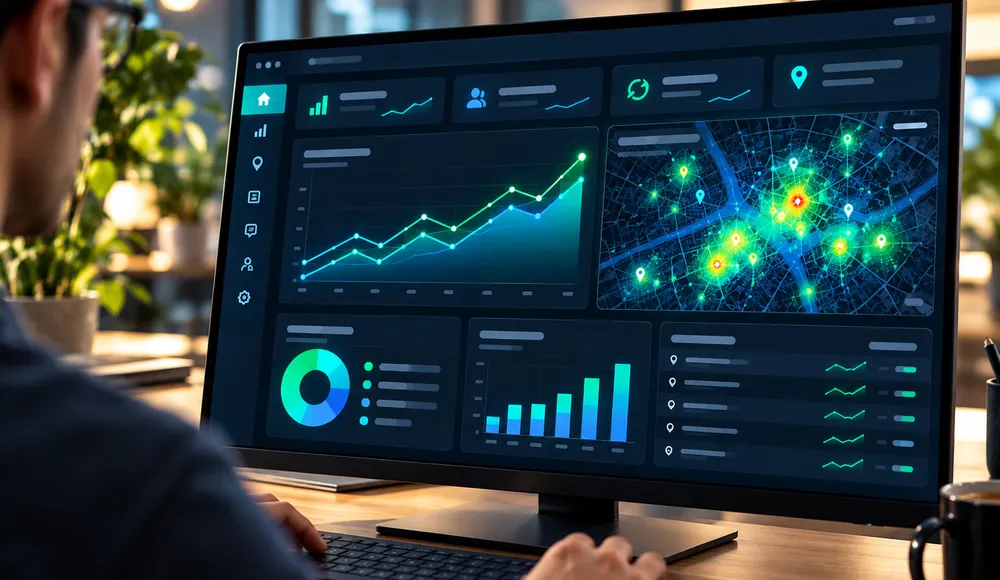
In Google Search Console: monitor impressions and clicks for local-intent queries ("[service] in [city]"). If impressions are rising but clicks are flat, you may be appearing in AI summaries where users get their answer without clicking — track branded search volume as a proxy for AI pack visibility.
AI referral tracking: segment your analytics by referrer. ChatGPT, Perplexity, and Claude send referral traffic that shows up as "chat.openai.com," "perplexity.ai," and "claude.ai" in your referral reports. This traffic is currently small but growing — and it converts at a different rate than organic. Set up a separate segment now so you have baseline data.
Manual testing: run your top ten local queries in Google AI Mode, ChatGPT, and Perplexity monthly. Document which businesses get cited, what content they are cited from, and where you appear. This qualitative audit reveals gaps no automated tool catches yet.
Review velocity monitoring: track your weekly review count against competitors. Whitespark and BrightLocal both offer tracking. A declining velocity relative to competitors is an early warning signal for AI pack displacement.
Common Mistakes That Suppress AI Local Pack Rankings
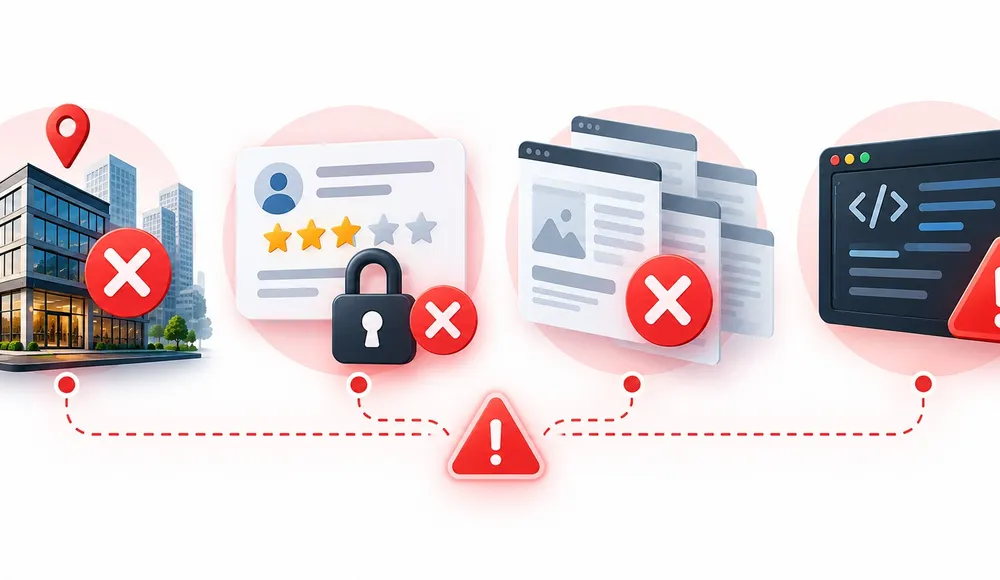
Fake or virtual offices: Google's guidelines prohibit listing an address you do not staff. If you serve a city remotely, use a Service-area business setup with the city in your service areas — do not invent a coworking-space address. This is the fastest way to get suspended.
Review gating: filtering out negative reviews before they publish violates Google's guidelines and is increasingly detectable. AI engines also read review sentiment patterns — a suspiciously perfect 5.0 with no negative reviews reads as less trustworthy than a genuine 4.7 with thoughtful owner responses.
Thin city pages: a page with only the city name swapped into a template is filtered by Google's Scaled Content Abuse policy and ignored by AI engines. Each city page needs genuinely unique local content — neighborhoods, industries, pricing, case studies. The test: delete the city name from every sentence. Would the page still make sense? If yes, it is a doorway page.
Missing schema: without LocalBusiness, FAQPage, or Service schema, AI engines must guess at your business details. Schema removes ambiguity. It is not a ranking silver bullet (Ahrefs' May 2026 study found no causal citation uplift from schema alone), but it is a correctness baseline.
No answer capsules: if your key pages do not lead with a direct 40–60 word answer, AI engines have nothing to extract. They will cite a competitor whose page does. Every commercial page on your site should pass the "can this paragraph be quoted verbatim" test.
Action Framework
Ship-It Checklist
- Primary GBP category audited against highest-value service query.
- Weekly review velocity target set (2–4 per week) with a request flow after every engagement.
- All reviews responded to within 48 hours, with service and city mentioned in the response.
- GBP posts published weekly; photos uploaded 2–3 times per week with descriptive filenames.
- Top ten customer questions seeded as GBP Q&A pairs.
- LocalBusiness (or Service + serviceArea) schema implemented with accurate NAP and geo.
- FAQPage schema on every page with FAQ content.
- Answer capsule (40–60 words) added after H1 on every service page, city page, and cost page.
- Neighborhood and suburb names woven into body copy on city pages (not hidden lists).
- Google reviews displayed on website with structured markup.
- Monthly manual test: top ten local queries run in Google AI Mode, ChatGPT, and Perplexity.
- AI referral traffic segment set up in analytics (chat.openai.com, perplexity.ai, claude.ai).
- Review velocity tracked against top three local competitors monthly.
- City pages audited against the "strip the city name" doorway test.
FAQ & Decision Rules
Frequently Asked Questions
What is the Google AI Local Pack?
The AI Local Pack is Google's AI-generated summary of local businesses that appears alongside or above traditional local search results. Instead of a map with three pins, it shows a prose answer synthesized from Google Business Profile data, website content, reviews, and third-party mentions. It appears on approximately 68% of local business queries as of mid-2026.
How is AI Local Pack ranking different from the classic map pack?
The classic map pack is driven primarily by GBP signals: primary category, proximity, review count and rating, and behavioral signals. The AI Local Pack layers on additional signals — your website's content depth, AI search citations (how often ChatGPT and Perplexity cite your brand), social signals, and review velocity (cadence over total count). Most importantly, the AI pack reads your website; the classic pack largely does not.
How do I get my business into the AI Local Pack?
Optimize your GBP (primary category, weekly review velocity, posts, photos, Q&A), implement LocalBusiness and FAQPage schema on your website, add answer capsules to every key page, name neighborhoods in your city-page copy, and build citation-ready content (cost pages, case studies, FAQ blocks). The website work is what most businesses are missing.
Does review count still matter for AI Local Pack?
Yes, but review velocity matters more. A business with 80 reviews gaining four per month will increasingly outrank one with 300 reviews and none this year. AI engines also quote specific review text — detailed, service-specific reviews give them more to cite than generic five-star ratings.
Do I need a physical office in every city I want to rank for?
No. If you serve a city remotely, set up your GBP as a service-area business with that city in your service areas. Do not list an address you do not staff — virtual offices and coworking addresses violate Google guidelines and risk suspension. Your city pages on your website do the local relevance work without needing a GBP per city.
How do I measure if I am appearing in AI Local Pack results?
Three methods: monitor branded search volume in Search Console as a proxy (rising branded search often means AI pack visibility), segment analytics by AI referral traffic (chat.openai.com, perplexity.ai, claude.ai), and run monthly manual tests of your top ten local queries in Google AI Mode, ChatGPT, and Perplexity, documenting which businesses appear.
Sources
- Google - Representing your business on Google
- Whitespark - 2026 Local Search Ranking Factors
- Google - Optimizing for generative AI features
The 32% figure is the AI Local Pack shortlist reduction reported in the research this article analyses. The factor weights come from the 2026 Whitespark survey - expert opinion, not a published algorithm.
Written by Rohan Verma • Frontend Engineer
Ships the interface clients touch daily — fast, accessible, maintainable — and owns the site's rendering, performance and structured-data layer.
Technical SEO ArchitectureCore Web VitalsStructured Data & SchemaAnswer Engine Visibility
Published on 2026-10-10. Last updated 2026-10-22.
Reviewed for technical accuracy by Shruti Mehta, Founder.
For clarifications or corrections, email contact@anyplacehub.com.
Figures and illustrations on this page: illustrations are AI-generated, not photographs or client screenshots. Statistics are either linked to a published source or labelled in the text as a rule of thumb from our delivery work. See the editorial policy.