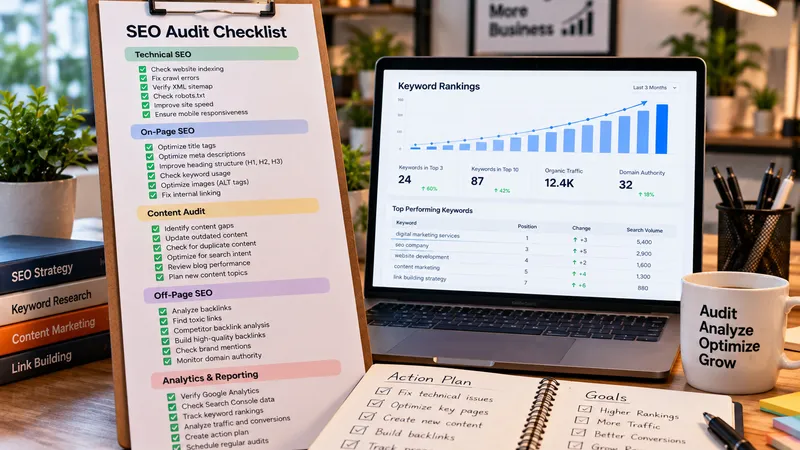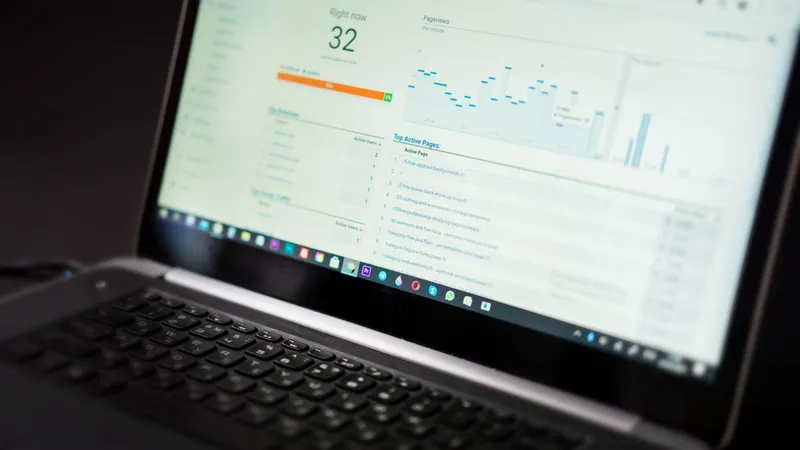
- Local SEO is a different game from organic SEO: the map pack is decided by relevance, distance and prominence — profile completeness, reviews, citations and on-site signals — not by domain authority alone.
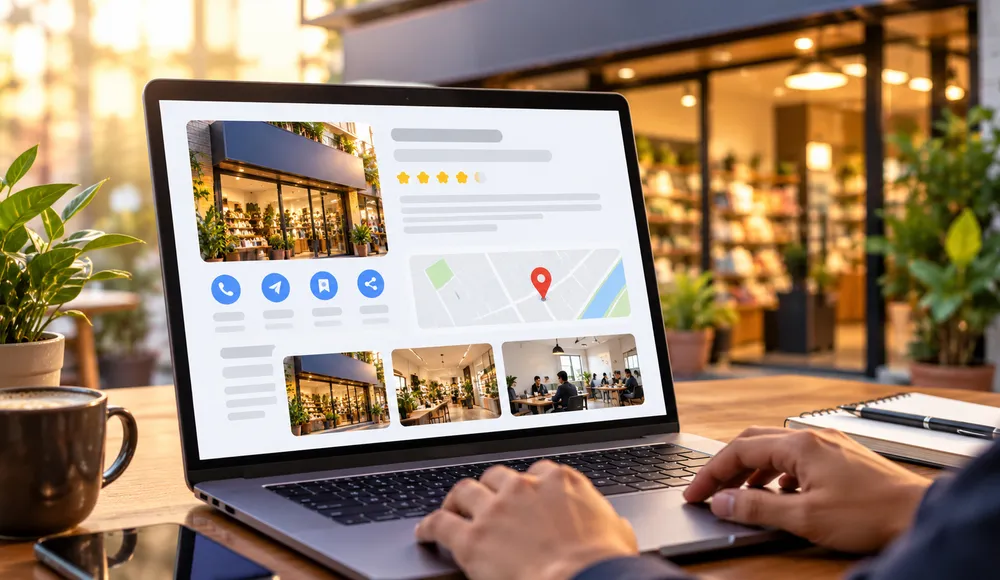
- Your Google Business Profile is the ranking asset. Primary category, services list, hours, weekly photos and a seeded Q&A section move visibility faster than any blog post.
- NAP consistency — the same business name, phone and full street address everywhere — is the cheapest ranking input you control. One wrong suite number on ten directories undoes weeks of work.
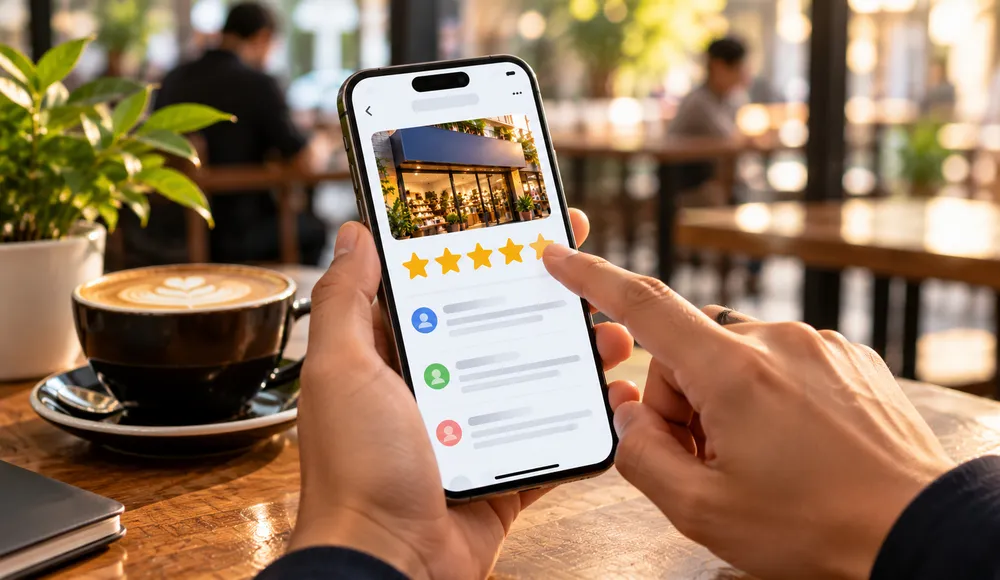
- Reviews win the click even when they do not win the rank: velocity, recency and owner responses influence both the pack and the AI answers that quote your listing.
- Realistic timeline: a complete profile shows effect in two to four weeks; meaningful map-pack movement takes one to three months, longer in competitive categories. Anyone promising week-one #1 is selling something else.
Local SEO is the practice of making your business the obvious answer when someone nearby searches for what you sell — 'dentist near me', 'software company Hisar', 'cafe open now'. In 2026 those searches resolve in three places: the map pack (Google Business Profile results), the organic listing below it, and increasingly the AI answer that summarises a few local options before showing any link. Winning local means feeding all three with the same consistent, complete information.
The economics are what make local SEO worth doing for every Indian SME. You compete against businesses in your own city rather than national publishers, the work is concrete rather than speculative, and the inputs are mostly free: a complete profile, an address formatted identically everywhere, photographs, reviews you ask for, and pages that describe where you actually operate. This guide runs the full system in order — the twelve-point Google Business Profile checklist, NAP consistency and citations, review velocity, location pages with LocalBusiness schema, how local intent surfaces in AI answers, and what each piece realistically costs.
Two companion reads: the 40-point SEO checklist covers the technical foundation this sits on, and the SEO cost guide covers the money side. The address format used across this site — one canonical string in the profile, the footer, the contact page and every citation — is exactly the discipline this article describes; you can see it live on our Hisar office page.
1. Why local SEO behaves differently from organic SEO
Organic ranking leans on authority, content depth and links. The map pack leans on three inputs Google states plainly: relevance (how well your profile matches the query), distance (where the searcher is), and prominence (how known and trusted you are — reviews, citations, mentions, engagement). You cannot buy distance and you only partly influence prominence, so most local work is relevance and prominence: choosing the right categories, listing every service, collecting reviews steadily, and keeping your information identical across the web.
The query mix also differs. Local intent shows up as 'city + service', 'near me', 'open now' and voice queries, and it converts hard — someone searching 'AC repair Hisar' is calling today, not reading a whitepaper. That intent density is why a single map-pack position can outperform page-one organic for service businesses, and why local SEO is usually the highest-return marketing line item a small Indian business has.
Measurement has to match the difference. Track map-pack visibility separately from site impressions: watch profile metrics (searches, views, direction requests, calls, website clicks) inside Google Business Profile weekly, and track branded and city-plus-service queries in Search Console monthly. A page can slip in organic while the profile climbs the pack — those are different races with different fixes.
2. Google Business Profile: the 12-point setup that actually ranks
Start with categories, because they weight everything else. Pick one primary category that matches what you want to be found for (the most specific accurate choice — 'Software Company', not 'Marketing Agency' if software is the business), then add secondary categories for genuinely offered services. Fill services and products with the exact phrases customers use, including the city where it reads naturally, and write the 750-character description with your real offerings in the first two lines, since everything after that is truncated in most views.
Then the completeness pass: accurate hours including holiday hours (Google logs staleness), a tracking-tagged website link, phone that matches the site, attributes that apply (wheelchair access, women-led, delivery), attributes do not guess — wrong ones are removal-worthy. Add photographs weekly — exterior, interior, team, work in progress, vehicles — because profiles with fresh photos get materially more engagement, and post an update or offer monthly so the listing looks alive. Seed the Q&A section yourself with the six questions customers actually ask (parking, timings, payment, turnaround, appointments, area served) and answer them publicly.
Two rules protect the asset. First, the business name field must match your real-world signage — keyword-stuffed names ('Best SEO Agency Hisar Cheap') are the fastest route to suspension, and suspensions are slow to unwind. Second, service-area businesses must not list a P.O. box as the address; either show a verified premises customers can visit or hide the address and define service areas by city, exactly as our Hisar listing does.
3. NAP consistency: the detail that quietly decides trust
NAP — name, address, phone — is the identity spine of local SEO. Search engines cross-check your profile against directories, social accounts, citations and your own website to confirm you are one real business at one real place. Google normalises case and punctuation when comparing, so 'Beside' and 'beside' do not conflict — but the components must match: the same house or khasra number, the same street, the same locality, the same PIN code, the same phone format everywhere.
Practically: choose one canonical address string — for example 'KHASRA NO.4373/17, Beside Dabra Chowk Flyover, Near Surya Hospital, Urban Estate II, Hisar, Haryana 125001' — and use it verbatim on your Google profile, website footer, contact page, schema markup and every citation. Then work the Indian citation set: Justdial, Sulekha, IndiaMART, Yellow Pages equivalents, Apple Business Connect, Bing Places, Facebook, Foursquare, plus industry directories (Clutch and GoodFirms for agencies, Practo for clinics, Justdial verticals for retail). One wrong suite number on the top ten directories costs more than a month of content.
Audit it in an afternoon: search your exact business name plus city, open the top twenty results, and log every NAP variant you find in a spreadsheet. Fix the mismatches, claim the listings you can control, and repeat quarterly. For multi-city businesses, run the audit per location — each branch has its own NAP and its own profile, and mixing them dilutes both.
4. Reviews: velocity, responses and what actually moves rank
Reviews influence rank through volume, velocity (recent rate), recency, rating distribution and keyword diversity — customers describe your services in their own words, which feeds both the pack and AI answers. The reliable system is boring: ask every satisfied customer, every time, through a channel they already use. WhatsApp with the direct review link, a QR code at the counter, a follow-up message after delivery, an invoice footer line. One ask per completed job typically converts 10–30% — far more than any campaign.
Never gate or buy reviews. Incentivised reviews, review gates ('only happy customers get the link') and bulk purchased ratings violate platform policy and are increasingly detected; the penalty falls on the profile, not the vendor who sold them. Report competitor spam through the profile's redressal form instead of matching it. Owner responses matter on every review — short, specific, no template — because they show in the listing and signal engagement; answer negative reviews within 48 hours with a fix, not an argument.
Reviews also do double duty as content. Your best reviews contain 'near Hisar', 'same-day AC repair', 'fixed price' — the exact phrases future customers search. Surface them: quote them on location pages, add review schema where it qualifies, and keep the flow steady rather than in bursts, because a profile that collects twelve reviews a year for three years reads as established, while forty in one week reads as manufactured.
5. Location pages, service-area signals and LocalBusiness schema
Your website has to confirm what the profile claims. For a single location: put the canonical NAP in the footer and contact page, add a click-to-call button on mobile, embed the map, and mark up the page with LocalBusiness schema carrying streetAddress, locality, region, postalCode, country, geo coordinates, openingHoursSpecification, telephone, url and sameAs (your social and profile links). Validate the JSON after every change — malformed schema is ignored silently, which is the most common local SEO bug we audit.
For multi-city businesses, build one genuine page per city: unique copy describing real work in that city, the city's NAP if you have an office there, an embedded map, that city's reviews or case examples, and internal links from your service pages. Avoid doorway pages — thin 'Service in City' shells that differ only in the city name. Google's helpful-content systems target exactly that pattern, and one strong page per city beats five weak ones every time.
Service-area businesses (no public premises) should hide the address on the profile, list service areas, and still publish location pages framed around where you work, not where you sit. Add an FAQ block on each location page in the questions customers actually ask — 'Do you visit Sector 14?', 'Which areas do you cover?', 'How fast can you reach us?' — because those plain question-and-answer pairs are what AI assistants quote when someone asks for a recommendation.

6. Local SEO in the age of AI answers
The local result increasingly arrives as a sentence, not a list. Ask ChatGPT, Perplexity or Google's AI mode for 'a reliable software company in Hisar' and you get two or three named businesses with reasons — assembled from the profile, reviews, citations, directory listings and clear on-site content. Nothing about that changed the inputs; it raised their stakes, because an AI answer cites the sources it finds clearest and most consistent.
To be quotable: keep the entity unambiguous (same name, address, phone, category everywhere), maintain complete profile data, keep a steady review stream with descriptive wording, publish question-shaped answers on your location and service pages, and expose machine-readable context — schema markup, a sitemap, an llms.txt style summary of who you are and where you operate. Consistency beats volume here; three accurate authoritative sources outquote twenty scattered ones.
Track it manually once a month: ask the two or three assistants you care about for your category in your city, note who appears and why, and fix the gaps in your own data. Branded search volume in Search Console is the lagging indicator — when local content and reviews compound, 'your name + city' queries are what climb first.

7. What local SEO costs, and when to hire
The do-it-yourself route costs time rather than money: profile setup and a citation pass take a weekend, then three to five hours a week for reviews, photos, posts and page upkeep. It works well for one location in a low-competition town. The risk is not execution but neglect — profiles decay when nobody owns the weekly habit.
If you hire, local SEO sits at the affordable end of the market: roughly ₹8,000–₹25,000 a month for a single-location programme — profile management, citations, review system, location page and reporting — with project work (setup, audit, migration) priced separately. See the band breakdown in the SEO cost guide and our own published pricing. Compare proposals on deliverables named per month, not on the rupee figure.
Red flags, briefly: guaranteed #1 in a week, requests for your profile credentials with no contract, keyword-stuffed business names, review buying, and citation blasts across five hundred irrelevant directories. And the timeline to hold them to: profile completion in week one, citation consistency within the first month, review flow live from week one, measurable pack movement in one to three months. If you want a scoped plan for your city, send us the business name and category and we will map the same checklist to your competition.

8. Your first 30 days: the local SEO sequence
Week one is foundations: finish the twelve-point profile checklist, publish the canonical address string to the site footer, contact page and schema, and verify LocalBusiness markup with Google's Rich Results Test. Turn on the review request the same week — the system only compounds if it starts before you feel ready.
Week two is consistency: claim and correct the top twenty citations for 'brand + city', add Apple Business Connect and Bing Places, upload exterior, interior and team photos, and seed the profile Q&A. Week three is the website: refresh the location page, write the FAQ block in customers' own questions, and link service pages to it so crawlers see the relationship.
Week four is measurement and habit: record the profile's baseline metrics (searches, views, calls, directions), confirm Search Console has your city-plus-service queries, and lock the weekly thirty-minute routine — new photos, respond to reviews, one post. Then let velocity do its work for sixty days before judging results, and revisit the 40-point checklist for the technical layer underneath all of this.
Action Framework
Ship-It Checklist
- Primary Google Business Profile category matches your main revenue service; secondary categories cover the rest.
- Services and products listed in full, using customer phrasing plus city where it reads naturally.
- Hours accurate including holidays; phone and website link verified; tracking UTM on the profile link.
- Exterior, interior, team and work photos added — then a new photo every week.
- Q&A section seeded with six real customer questions and answered publicly.
- One canonical address string used verbatim on profile, footer, contact page, schema and all citations.
- Top 20 search results for 'brand + city' audited for NAP mismatches; mismatches corrected.
- Claimed listings on Justdial, Sulekha, IndiaMART, Apple Business Connect, Bing Places, Facebook plus one industry directory.
- Review request wired into every completed job (WhatsApp link, QR code, follow-up message).
- Owner response left on every review within 48 hours; no gating, no incentives, no purchases.
- LocalBusiness schema present and validated on contact and location pages (streetAddress, geo, hours, sameAs).
- FAQ block on each location page written as plain questions and answers for AI assistants to quote.
FAQ & Decision Rules
Frequently Asked Questions
How long does local SEO take to show results in India?
Profile completeness and citation fixes register within two to four weeks. Meaningful map-pack movement typically takes one to three months, depending on category competition and review velocity. Competitive categories in metros take longer. Anyone promising #1 in a week is either buying risk for you or ignoring how the ranking system works.
Does Google Business Profile really affect website ranking?
Directly it drives the map pack, which is separate from organic results. Indirectly it strengthens the same signals organic ranking uses: consistent entity information, reviews, local mentions and click-through from branded searches. Businesses that neglect the profile usually see both channels soften together.
How many reviews do I need to rank in the map pack?
There is no fixed number — velocity, recency and rating distribution matter more than the absolute count, and the competitive bar is set by whoever currently ranks. A steady flow of one to three genuine reviews per completed job outperforms a large but static total collected two years ago.
Should I create a page for every city I serve?
Only where you can write something real for that city: work performed, reviews, team presence, photos or case examples. Thin templates that swap the city name are doorway pages. For service areas without offices, one strong area page plus service pages that mention coverage honestly usually beats many weak ones.
Is local SEO different for service-area businesses without a shop?
Yes — hide the address on the profile, define service areas by city or region instead, and keep the phone number local. Your location pages then describe where you work rather than where customers visit, and reviews plus citations carry more of the prominence signal than proximity does.
How does AI search change local SEO?
AI assistants summarise local options from the same corpus — your profile, reviews, citations and clear on-site answers. The practical additions are consistency across sources, question-shaped content, schema markup and machine-readable context. The fundamentals are unchanged; sloppiness is just punished faster.
Written by Divya • AI-Search & Growth Engineering Strategist
Leads technical search architecture, Core Web Vitals optimization, and generative AI answer engine optimization (AEO/GEO).
AEO & GEO OptimizationTechnical SEOGrowth EngineeringSchema Markup
Published on 2026-10-06. Last updated 2026-10-06.
Reviewed for technical accuracy by Shruti Mehta, Founder.
For clarifications or corrections, email contact@anyplacehub.com.