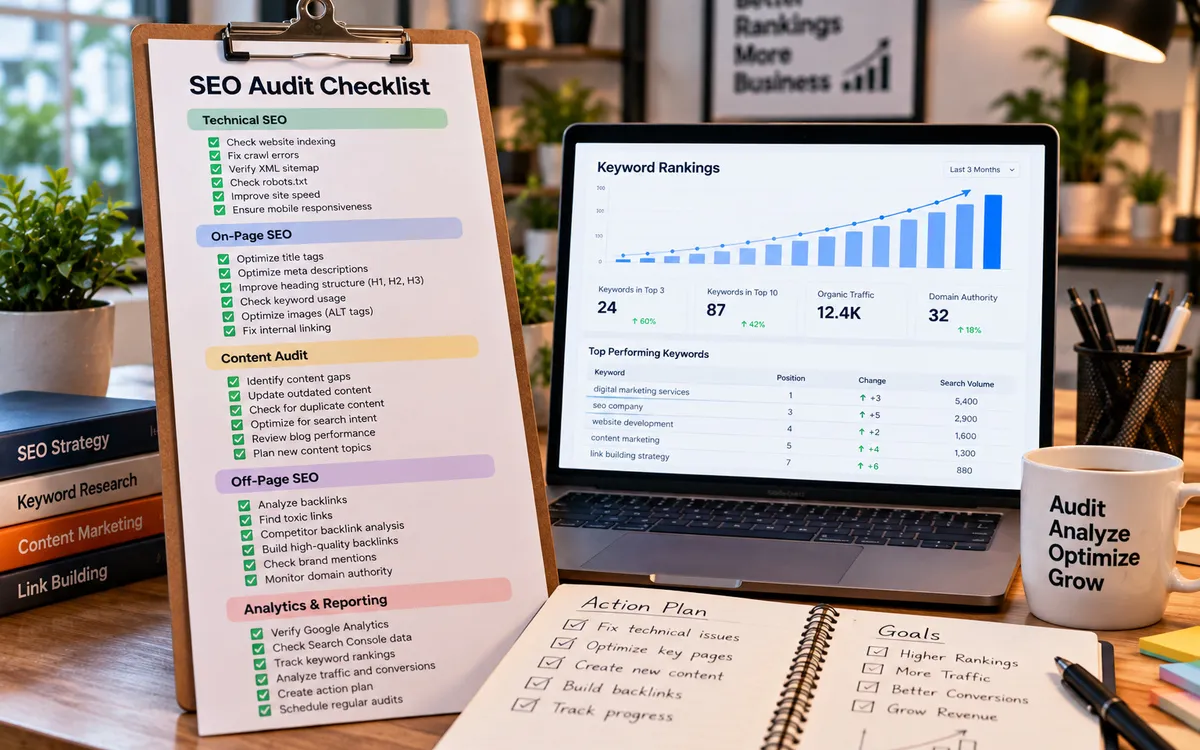
- Run the checklist in dependency order — setup before keywords, keywords before content, content before links. Skipping ahead means optimising pages nobody can measure or find.
- Not everything takes the same time: crawl and index fixes can move in days, on-page edits in two to eight weeks, content and authority in one to three quarters. Judge each fix against its own timeframe, not a single deadline.
- Local businesses have an outsized shortcut: a complete Google Business Profile, consistent NAP and genuine reviews move the map pack faster than any on-page tweak. NAP consistency beats citation count.
- AI-search readiness is not a separate project — clear answers, structured data, consistent facts and crawlable pages are what earn citations in AI answers and classic rankings alike.
- Re-run the full audit quarterly. Rankings regress quietly: a plugin adds noindex, a redesign drops schema, a redirect chain appears. The cadence is the moat.
An SEO checklist is the difference between 'we should do SEO sometime' and a sequenced audit that produces measurable movement. The forty points below cover everything that actually moves rankings — setup and tracking, keyword research, on-page, technical health, content and authority, local signals, and AI-search readiness — ordered by dependency so you never spend a week polishing titles on a page that search engines can't even index.
Most SEO failures are sequencing failures. Teams start with backlink shopping while the site still serves mixed content; they write beautiful articles while Search Console shows half the site excluded from indexing; they redesign the homepage while conversion tracking is broken and can't tell whether anything improved. Order matters more than effort here, which is why this checklist runs foundations → keywords → on-page → technical → content and links → local → measurement.
The checklist works two ways: as a one-time audit for a site you've just inherited or launched, and as a quarterly re-run for a site that's been drifting. Every item includes a sense of how long results take — days for indexation fixes, two to eight weeks for on-page changes, one to three quarters for content and authority — so progress gets judged fairly. For the strategy these tactics feed, read the 90-day SEO and AI-answer plan; for local ranking specifically, our Hisar location page shows the local-pack playbook in practice.
Forty points. Work top to bottom the first time; then treat it as a recurring audit where every unchecked box becomes a task in the next sprint.
Two working notes on scope. First, nothing here requires an enterprise budget — every item is achievable by a small team or a single developer with a checklist and a quarterly rhythm; the tools involved are largely free (Search Console, PageSpeed, schema validators, business-profile editing). Second, several items are one-time (domain and property setup, initial cluster mapping) while others are permanently recurring (review responses, content refreshes, sitemap lastmod). Separate the two lists on day one so recurring work never gets misfiled as setup and quietly abandoned.
Keep the audit itself stupidly simple: one spreadsheet with a row per point — status, evidence link, owner, target date — and nothing fancier until the spreadsheet stops working. The evidence column is what makes the audit honest six months later: a link to the Search Console screenshot, the live URL, the validator output. Claims without evidence get re-litigated; evidence gets ticked and closed.
1. How to use this checklist (and how long each fix takes)
First pass: audit in order and record a baseline for every measurable point — current indexed-page count, target keyword positions, Core Web Vitals scores, map-pack presence, monthly organic sessions. Without a baseline, later 'improvements' are vibes. Tick only what you've verified in a tool or the live site; half-done items hide as ticks and resurface as problems three months later.
Timeframes differ wildly by fix type, and misjudging them is why teams quit SEO early. Indexation and crawl fixes can show movement in days to a few weeks. Title tags and internal-link changes typically move impressions within two to eight weeks. Core Web Vitals field data updates on a rolling window of about 28 days after deployment. Content, authority and local results compound over one to three quarters. Diarise each fix against its own clock.
Re-run mode: quarterly, walk the full list again. Sites regress quietly — a new plugin sets noindex on a template, a redesign drops structured data, an app update introduces redirect chains, a CDN change breaks sitemap submission. The quarterly audit converts drift back into a short task list instead of a mystery traffic drop.
Effort allocation for most SMEs: technical and on-page consume the first two weeks, local signals the third, content and links become the monthly recurring rhythm, and measurement is permanent. If an item needs a developer (schema, speed, rendering), batch them into one ticket rather than dribbling requests across the quarter.
2. Foundations: tracking, verification, and baselines
Google Search Console is the non-negotiable first step: verify the property (DNS or file), confirm the correct domain and www/non-www canonical version, and submit an XML sitemap that lists only canonical, indexable URLs. Add Bing Webmaster Tools too — AI assistants lean on its index more than most teams realise, and its audit tools are free.
Analytics comes next: GA4 (or your chosen tool) collecting page views and conversions with consent handled properly, plus conversion events wired for the outcomes that matter — form submissions, calls, purchases. A site with rankings but no conversion measurement can't distinguish traffic growth from business growth, which is the entire point of the exercise.
Capture the baseline numbers now: pages indexed vs submitted in Search Console, current positions for your five money queries, mobile and desktop Core Web Vitals for key templates, and organic conversions last month. Screenshot or sheet it — this is the 'before' half of every 'SEO didn't work' argument you'll have later.
Finally, confirm index hygiene basics in the same session: robots.txt not blocking assets or sections unintentionally, no accidental noindex on templates, HTTPS sitewide with no mixed content, and a site that renders its primary content without requiring JavaScript execution for crawlers. Five checks, one afternoon, and they invalidate dozens of downstream efforts if wrong.
Handle consent and cookie banners properly while you're in setup: analytics that silently stops collecting for most visitors makes every later comparison fictional, while banners that block rendering on mobile break Core Web Vitals before any content loads. Configure consent mode so measurement degrades honestly rather than to zero, keep the banner from pushing layout, and document which events survive consent — you want foundations that tell the truth about partial data, not numbers that look complete and aren't.

3. Keyword research and intent mapping
Start from customers, not tools: list the problems your buyers actually search — their vocabulary, not your service-page jargon. Expand with autocomplete, People Also Ask, Search Console's existing query report, competitor gaps, and community language. Only then open a keyword tool for volumes and difficulty, because a low-volume term with buying intent beats a ten-thousand-search term that never converts.
Group by intent before you group by words. Informational ('how to'), commercial ('best', 'vs', 'pricing'), transactional ('buy', 'book', 'near me'), navigational (brand terms). Check the live SERP for each target: if page one is all product pages, an informational article won't rank — intent is decided by Google's results, not your label.
Cluster same-intent keywords into one page each — one primary keyword plus natural variations per page — and map the cluster before writing. This is the single highest-leverage step: it prevents cannibalisation, where three of your own pages compete for one query and all three lose. If multiple pages already target one intent, consolidate or sharply differentiate them.
Prioritise with a simple score: volume × difficulty × business value, weighted toward value. Produce a one-page map — keyword cluster → target page → funnel stage → current position → target position. Every later checklist item (titles, internal links, content briefs) reads from this map, so the twenty minutes spent here save the next twenty hours.
Guard the map against two classic distortions. The first is vanity: a glamorous head term that your site could not rank for in three years pulls effort away from twenty long-tail queries you could own in a quarter — head terms are won later, after the long tail funds the authority that makes them realistic. The second is internal politics: 'this page matters because the CEO likes it' is not a scoring input. If a term has no business value and no realistic path, it belongs on the someday list, not the sprint.

4. On-page SEO: the edits that compound
Titles and meta descriptions carry the first-page click decision: unique title per page with the primary keyword near the front, meta descriptions written as a pitch (they don't rank, they convert). Keep titles around 50–60 characters so they don't truncate, and never ship two pages sharing a title template verbatim.
The H1 states the page's topic once; H2s and H3s structure the argument the way a reader skims it — questions as subheadings work especially well because they match both featured snippets and AI-answer extraction. Place the primary keyword naturally in the H1, first paragraph, one or two subheads, and the URL; then write for humans and stop counting densities — density targets read badly and do nothing.
Internal links are the cheapest ranking lever available: link from established pages to priority pages with descriptive anchor text (not 'click here'), keep depth shallow so every money page is within three clicks of the homepage, and add links to older posts whenever you publish new ones. Orphan pages — no internal links pointing at them — receive no equity and often don't rank at all.
Finish with media and snippets: descriptive alt text on images (it feeds both image search and AI context), schema where it matches the content (Article, FAQ, Product, LocalBusiness, Breadcrumb), Open Graph tags for social sharing, and a clean breadcrumb trail. Then move to the machinery underneath — because perfect on-page on an unindexable page is decoration.
Update beats republish when intent still holds: pages already earning impressions often move with a rewritten introduction, a fresher example, an expanded answer section and a new date — far cheaper than a new URL competing with your own history. Keep the URL, keep the backlinks, refresh the substance, and only change the date when the content genuinely changed. Scheduled quarterly refreshes of your top twenty ranking pages usually outproduce twenty new posts.
5. Technical SEO: crawl, index, and speed
Crawlability first: robots.txt permits the pages you want ranked; XML sitemap submitted, current, and listing only canonical URLs with accurate lastmod; no redirect chains or loops (every hop leaks authority and wastes crawl budget); 404s resolved with 301s to genuinely relevant replacements, not blanket redirects to the homepage.
Indexation next: in Search Console's Page Indexing report, every important page should be 'Indexed'. Investigate exclusions — 'Crawled – currently not indexed' often means thin content; 'Discovered – currently not indexed' means crawl priority problems; 'Duplicate without user-selected canonical' means canonical tags are misconfigured. Fix causes, not symptoms, and re-request indexing after repairs.
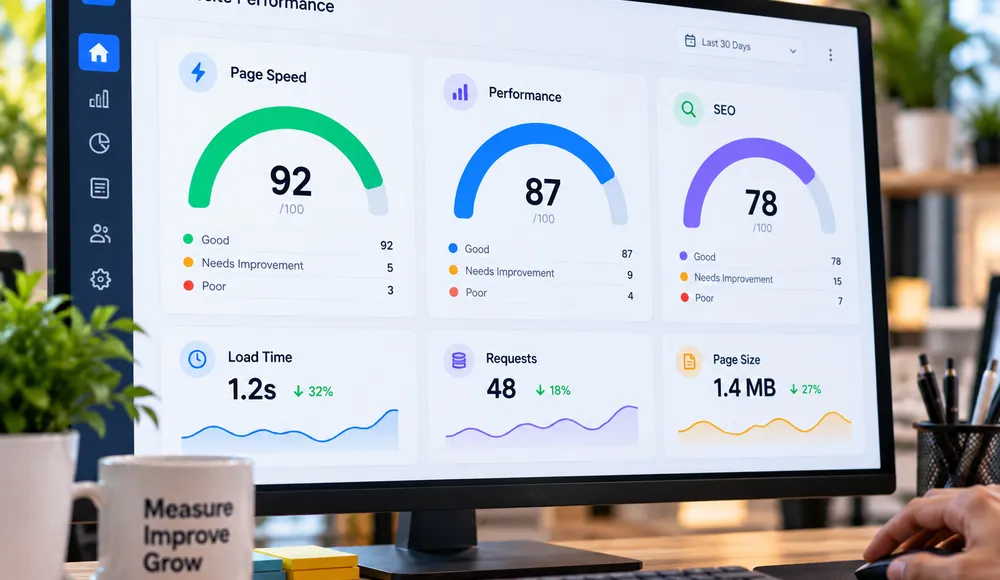
Speed and stability: Core Web Vitals pass at the 75th percentile of real users — Largest Contentful Paint under 2.5 seconds, Interaction to Next Paint under 200ms, Cumulative Layout Shift under 0.1 — measured on mobile, on your key templates, not just the homepage average. Fix the worst-scoring metric first: compress images, reserve space for late-loading elements, trim render-blocking scripts.
Structure and security wrap up the technical pass: one canonical URL form (HTTPS, consistent host, no trailing-slash duplicates), shallow logical architecture with descriptive URLs, mobile-first rendering where primary content exists in the initial HTML, and a valid canonical tag on every page consolidating duplicates. Technical SEO isn't about a perfect score — it's about removing every cap that limits everything above it.
Rendering deserves special suspicion on modern stacks: content that only appears after client-side JavaScript executes may be seen by crawlers late or partially — and answer engines, which often fetch without a full browser, may see an empty shell. Verify by comparing View Source against the inspected DOM on priority templates: primary headings, body copy and links should exist in the raw response. Hydration-heavy designs often need static generation for the pages carrying search value, even when the interactive app experience stays dynamic elsewhere.
6. Content, authority, and links
Audit existing content before creating more: find thin, stale, or cannibalising pages and either consolidate them into one strong page or improve them deliberately. One authoritative page outranks three overlapping thin ones, and consolidating consolidates their backlinks too. Prune with intent — merging into the stronger URL and 301ing the rest.
For new content, match depth to the query's job: comprehensive enough to be the last click, structured with headings, lists, tables and a clear answer early — because both rankers and answer engines extract the passage that answers the query, not your best paragraph buried at the end. Show first-hand proof: original screenshots, real numbers from your work, named authors with credentials. That's E-E-A-T in practice.
Links earn authority, and honest methods still work: original data or tools that others reference, expert contributions and partnerships, client and supplier site links, relevant industry directories with real traffic, and digital PR around something genuinely new. Skip bought links, comment spam, and private networks — they work until they don't, and the recovery costs more than patience ever would.
Measure authority the right way: referring domains (unique sites, not total links), branded vs non-branded query growth, and whether your target pages actually gain positions. Link metrics matter only in service of the keyword map from step three — if money pages aren't moving, authority is being spent somewhere else.
Editorial standards keep content from decaying into filler: every substantive page should carry a named author with relevant experience, a visible updated date that's honest, sources for any statistics it quotes, and at least one element that could only come from your actual work — a screenshot, a number from a delivery, a decision you made and can defend. This is E-E-A-T as practice rather than as a buzzword, and it doubles as the extraction quality answer engines quietly reward.

7. Local SEO: the map pack playbook
If you serve customers in a physical area, Google Business Profile is your single highest-return asset. Complete every field: accurate category (your primary category alone can decide map-pack eligibility), hours matching your website exactly, full address in one canonical format, services listed, description written, products or services populated, and real photos added monthly — profile completeness correlates directly with pack visibility.
NAP consistency follows: your name, address and phone must be identical — character for character — on your website, GBP, and the directories that matter in your market. Consistency beats count; ten correct citations outperform fifty conflicting ones, because engines resolve business identity by matching facts, not by tallying them. Fix the phone format everywhere first — it's the fastest inconsistency to spot and clean.
Reviews drive pack ranking and click-through: earn a steady stream of genuine reviews, respond to every one (positive and negative) within a day, and never buy reviews — detection is good and the penalty is disproportionate. On your site, add LocalBusiness structured data with the same NAP and embed a map on the location or contact page so page and profile corroborate each other.
Location content has to be real: pages and posts about the areas you serve, local questions you actually get, and context a city-wide template can't fake. Thin pages that swap one city name across twenty towns get filtered. Done well — profile complete, NAP identical, reviews flowing, local content genuine — the map pack moves in one to three months, often faster than organic blue links.
Cross-check the corroboration layer manually once a quarter: search your exact business name and phone number, and read what the results disagree about — old addresses on directories, a legacy spelling of your name, a second phone number from a previous office. Each disagreement is a small confidence deduction machines resolve by trusting the majority source, which may not be you. Fixing three stale listings usually beats building ten new ones.

8. AI-search readiness and measurement
Answer engines reward the same fundamentals with sharper extraction: pages that state the answer plainly near the question, FAQs in natural language, structured data marking up what's true, and consistent facts across your site, profiles and knowledge-base listings. If your page takes three scrolls to answer its own headline, both Google's AI answers and ChatGPT will quote someone else.
Entity clarity compounds: one consistent business name, one description, one set of NAP facts, schema connecting your organisation to what it does, and profiles (GBP, social, directories) that corroborate rather than contradict. Machines cite sources they can disambiguate — a business with three name variants and two phone formats is a citation risk before it's a candidate.
AI citations are measurable: monitor whether your brand appears in AI answers for your target questions (manual checks on ChatGPT, Perplexity and Google's AI results), track branded query growth as a proxy, and watch Search Console for impressions on the question-shaped queries your FAQs target. It's imperfect measurement, but trends are readable within a quarter.
Close the loop with a monthly review: keyword map positions, indexed-page health, Core Web Vitals, map-pack presence, organic conversions, and one thing you'll fix next. SEO doesn't fail from lack of tactics — it fails from lack of cadence. Forty points, checked quarterly, beat a hundred-point list checked never. When you want the audit run for you, our SEO and AI-search services follow this exact sequence, fixed-scope.

9. Failure modes: how good sites fail this checklist
Failure mode one — the unsequenced heroic sprint: forty fixes attempted in one week, none verified, half reverted by the next deploy. Sequencing exists precisely to prevent this. Fix foundations, confirm each change took effect in Search Console or the live site, commit, and only then move down the list. Verification is part of completing an item, not a separate chore for someone else.
Failure mode two — measuring what's easy instead of what matters: tracking impressions while nobody records where form submissions go. SEO that can't be tied to conversations and revenue becomes indefensible at the first budget conversation, and the first budget conversation always arrives. Wire conversions and CRM attribution in week one so every later claim about organic performance has evidence behind it.
Failure mode three — outsourced fragments with no owner: a freelancer doing links, a developer doing speed, an intern doing posts, and no one holding the keyword map. Fragments drift apart — the content team targets clusters the technical team's architecture can't support. One named owner, one shared map, one quarterly audit date. Ownership is the cheapest item on this checklist and the one most often skipped.
Failure mode four — auditing forever instead of shipping: polishing the checklist itself, re-litigating tool choices, delaying the first fix while researching the perfect process. The map you finished in step three is allowed to be eighty percent right on day one; a shipped fix this week beats an immaculate plan next quarter. Audit, fix the top three caps, re-measure, repeat — the cadence converts modest tactics into compounding results.
Action Framework
Ship-It Checklist
- Setup — Google Search Console verified for the correct canonical domain
- Setup — XML sitemap submitted listing only canonical, indexable URLs
- Setup — Bing Webmaster Tools configured (AI assistants lean on its index)
- Setup — GA4 collecting page views with conversion events wired
- Setup — baseline recorded: indexed pages, five money-keyword positions, CWV scores
- Setup — robots.txt permits key sections; no accidental noindex anywhere
- Setup — HTTPS sitewide, no mixed content, one canonical host form
- Keywords — customer-language seed list built before any keyword tool
- Keywords — queries grouped by intent: informational, commercial, transactional, navigational
- Keywords — live SERP checked per target to confirm real ranking intent
- Keywords — same-intent clusters mapped to one page each (no cannibalisation)
- Keywords — priority map scored on volume, difficulty and business value
- On-page — unique title per page, keyword-forward, 50–60 characters
- On-page — meta description written as click pitch on every priority page
- On-page — one clear H1; H2/H3s written as reader-skimmed questions
- On-page — primary keyword in H1, opening paragraph, subhead and URL naturally
- On-page — descriptive image alt text on all meaningful images
- On-page — Open Graph tags validated for social sharing
- Internal links — every money page within three clicks of the homepage
- Internal links — descriptive anchor text; no orphan pages on the site
- Internal links — new posts link to older priority posts and vice versa
- Technical — redirect chains and loops eliminated; 404s resolved with relevant 301s
- Technical — Page Indexing report reviewed; every exclusion investigated to its cause
- Technical — canonical tags correct on duplicates and near-duplicates
- Technical — Core Web Vitals pass on mobile for key templates (LCP, INP, CLS)
- Technical — primary content present in initial HTML (no JS-only rendering)
- Technical — sitemap lastmod accurate after every content change
- Content — thin, stale and cannibalising pages consolidated or improved
- Content — answer stated plainly near the question on every priority page
- Content — first-hand proof present: screenshots, real numbers, named authors
- Authority — referring domains tracked (unique sites, not total links)
- Authority — link acquisition from real sources: data, PR, partners, directories
- Local — Google Business Profile complete: category, hours, services, photos
- Local — NAP identical character-for-character across site, GBP and key directories
- Local — review flow live with responses within 24 hours on every review
- Local — LocalBusiness schema on site matches GBP exactly
- Local — real location content for served areas (no city-swap templates)
- AI search — FAQs in natural question form on all priority pages
- AI search — entity facts consistent across site, GBP, social and directories
- Measurement — monthly review installed: positions, index health, CWV, pack presence, conversions
FAQ & Decision Rules
Frequently Asked Questions
How long does SEO take to show results?
Indexation fixes can show in days; title and on-page changes typically move impressions within two to eight weeks; Core Web Vitals field data updates on a rolling window of about a month; content, authority and local results usually compound over one to three quarters. Competitive terms take longer than local ones.
What order should I complete the SEO checklist in?
Dependency order: tracking and index health first (you can't improve what you can't measure or crawl), then keyword mapping, on-page, technical depth, content and links, local signals, and measurement cadence. Skipping foundations means optimising pages search engines may not be indexing.
Do I need to do all 40 points?
The setup, on-page and technical items are not optional — they cap everything else. Local points apply if you serve a physical area; some authority items can wait until content is sound. Use the checklist as a scored audit: anything unchecked becomes a task, and the score should rise each quarter.
How often should I re-run the audit?
Quarterly for the full list — sites regress quietly through plugin updates, redesigns and app changes — with a lighter monthly review of positions, index health, Core Web Vitals, map-pack presence and conversions. A one-time audit is a snapshot; the cadence is the strategy.
Does SEO still work with AI answers and chatbots?
Yes — the same fundamentals power both. Answer engines extract clear, well-structured, citable passages with consistent facts and schema. Teams that win AI citations are doing orthodox SEO better: crawlable pages, plain answers near questions, entity consistency and genuine authority.
What is the fastest way to improve SEO?
Fix indexation and tracking (days), then internal links and title tags on priority pages (two to eight weeks), then Google Business Profile completeness and reviews if you're local (one to three months). Content and backlinks are the compounding work; clean up first so they aren't wasted on broken foundations.
Is local SEO different from regular SEO?
It adds a location layer: Google Business Profile optimisation, identical NAP across citations, review velocity and responses, LocalBusiness schema, and genuinely local content. Classic on-page and technical work still applies underneath — the map pack rewards both profile signals and site quality together.
Written by Divya • AI-Search & Growth Engineering Strategist
Leads technical search architecture, Core Web Vitals optimization, and generative AI answer engine optimization (AEO/GEO).
AEO & GEO OptimizationTechnical SEOGrowth EngineeringSchema Markup
Published on 2026-09-25. Last updated 2026-09-25.
Reviewed for technical accuracy by Shruti Mehta, Founder.
For clarifications or corrections, email contact@anyplacehub.com.