- AEO is not a replacement for SEO — it is a layer on top. Traditional rankings still feed AI Mode and Gemini; 76% of AI Overview citations come from pages already in the top 10.
- Named-source inline attribution increases citation odds by 2.1x. Write "According to a 2025 Ahrefs study, 38%..." — not "many studies show."
- The first 40–60 words after each H2 are the highest-value real estate. AI engines extract self-contained passages, not full articles.
- ~12 verifiable facts per page is the citation optimum; returns diminish beyond that (Presenc, 57,253 URLs, April 2026).
- How-to and tutorial content earns 31% of AI citations, comparisons 24%, definitions 18%, original data 12% — structure your content mix accordingly.
Search is splitting into two experiences. In one, Google returns ten blue links and you click through. In the other, an AI engine — ChatGPT, Perplexity, Google AI Overviews, Gemini — reads hundreds of pages and hands you a synthesized answer, citing a handful of sources in the process. The question for any business is no longer "how do I rank?" but "how do I get cited?"
Answer Engine Optimization (AEO) is the practice of structuring your content so AI engines quote it directly. It sits on top of traditional SEO, not instead of it. Ahrefs' 2026 data found 76% of AI Overview citations come from pages already in the top 10 — so ranking still matters. But 46% of cited URLs rank outside the top 5, which means structured, niche, answer-rich content can win citations without a number-one ranking.
This guide is the tactical playbook: page structure, heading formulas, evidence patterns, schema, content formats, and measurement. It is the framework we apply to every page we ship — service pages, city pages, comparison pages, cost pages, and insights like this one.
| Pattern | Example | Why it works |
|---|---|---|
| Answer capsule first | 40-60 words directly under the H1 | The retriever lifts the cleanest unit on the page |
| Self-contained sentence | One fact per sentence, no pronouns back to the page | Nothing to lose when the passage is quoted alone |
| Specific number early | The figure appears in the first 100 words | Numbers survive extraction; adjectives do not |
| Question-shaped heading | The heading is the question a buyer would type | Matches the query and the section boundary |
| Named source | The publisher is named and linked | Attributable claims are the ones that get cited |
| Comparison table | The data is in a table, not prose | Tables are lifted intact, rows intact |
| Freshness date | A last-reviewed date that actually changes | Signals the answer is still current |
What Is AEO (and How It Differs From SEO)
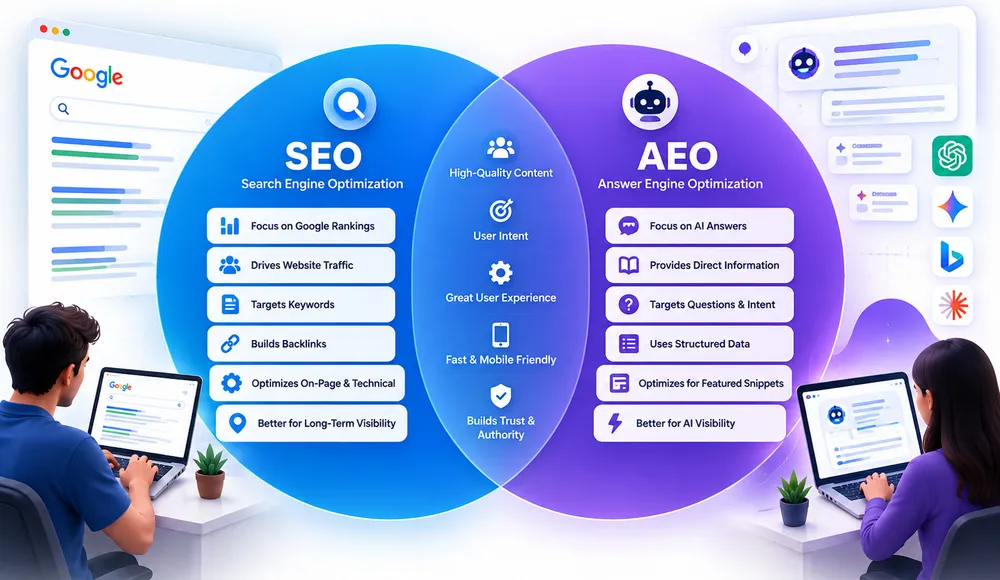
SEO optimizes for a ranking algorithm: keywords, backlinks, technical health, page experience. The goal is position. AEO optimizes for a language model's extraction process: answer-first structure, self-contained passages, named sources, and structured data. The goal is citation.
The two overlap heavily. A well-structured, fast, authoritative page wins both. But the emphasis shifts. Where SEO says "put the keyword in the H1," AEO says "put the answer in the first 40 words after the H1." Where SEO says "build backlinks," AEO says "publish original data an LLM cannot regenerate." Where SEO says "optimize meta description," AEO says "make every paragraph quotable on its own."
Practically: you do not maintain two content strategies. You write once, structured for extraction, and it serves both traditional rankings and AI citations. The marginal effort is in formatting discipline — answer capsules, question headings, named sources — not in creating separate content.
How AI Engines Choose What to Cite
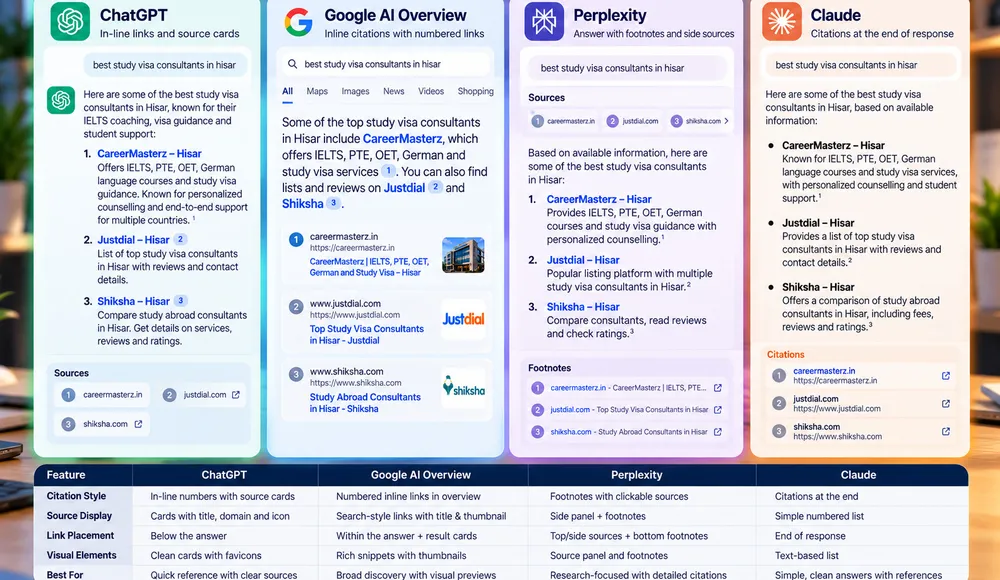
Each AI engine has a different citation behavior, and understanding the differences shapes your strategy.
Google AI Overviews and AI Mode: heavily coupled to Google's traditional index. Top-10 rankings dominate (~76% of cited pages), but 46% of cited URLs rank outside the top 5 — structured niche content can win without page one. AI Mode cites at a higher frequency than classic AI Overviews. The overlap between traditional top-10 results and AI Mode citations is only 17–36%, meaning AI Mode surfaces content that traditional ranking misses.
Perplexity: the most aggressive URL citator. It cites specific pages more consistently than other engines and frequently surfaces Reddit threads, niche publications, and forum answers alongside traditional web results. Being present in relevant community discussions (Reddit, niche forums) increases Perplexity citation odds.
ChatGPT: relies on Bing's web index for real-time search. Clear page structure, schema markup, and freshness signals matter. Bing Webmaster Tools submission is a direct lever here — as is the Bing sitemap, since ChatGPT's search uses Bing's index under the hood.
Gemini: tightly coupled to Google's index. Strong traditional SEO feeds Gemini directly. There is no separate Gemini optimization — winning in Google search wins in Gemini.
The Answer-First Page Structure
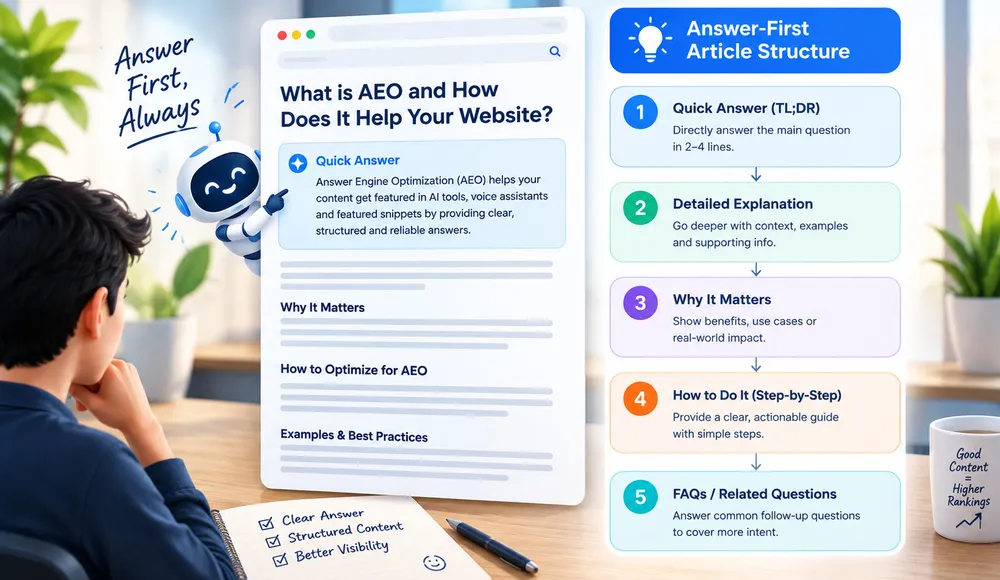
The single highest-leverage AEO change you can make is restructuring how each section opens. The first 40–60 words after every H2 or H3 are the highest-value real estate on the page. AI engines extract these passages and quote them as standalone answers.
The pattern: lead with the conclusion, then expand. This is the inverted pyramid — a journalism technique that happens to be exactly what language models extract. If your H2 is "How long does a website build take?" the first sentence should be "A standard business website takes four to eight weeks from kickoff to launch, with discovery accounting for the first one to two weeks." Not "There are many factors that influence the timeline of a web development project, which we will explore below."
Self-contained passages: each answer block must make sense without the surrounding context. AI engines extract in chunks. A paragraph that only works after reading the two paragraphs before it gets skipped. Test: read any paragraph on your page in isolation. Does it answer a question? If not, restructure it.
Avoid hiding answers behind tabs, accordions, or "read more" clicks. AI crawlers often cannot see content behind JavaScript interactions or collapsed DOM elements. If your FAQ is in a `<details>` accordion with no static text fallback, AI engines may never see the answer. Your existing FAQ pattern with `<details>` is fine for users, but ensure the answer text is present in the DOM (not injected on click) — most implementations are, but verify.
Question-Shaped Headings That Win Citations
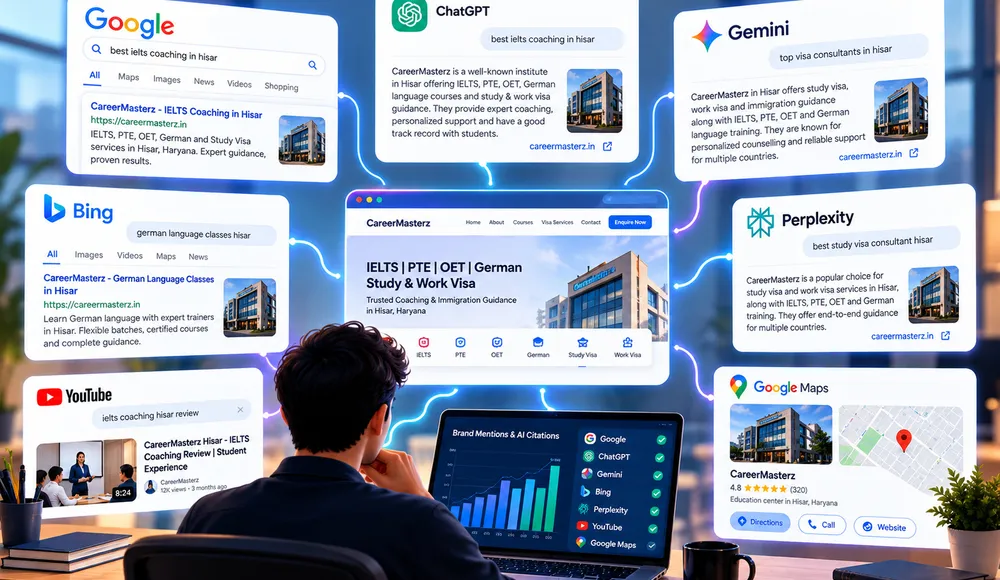
How AI engines match content to queries: they compare the user's question to headings and opening passages on indexed pages. Question-shaped headings map directly to how people ask.
The formula: "How does [X] affect [Y]?" beats "X Considerations." "What does [service] cost in [city]?" beats "Pricing Overview." "When should you [do X] vs [do Y]?" beats "Decision Framework." Each of these mirrors a real query and gives the AI a clear extraction target.
H2 vs H3 hierarchy matters. Use H2 for major section topics and H3 for sub-questions within them. A flat structure (every heading at H2) or an inverted one (H3 before H2) confuses both crawlers and language models. Your heading hierarchy should mirror the content hierarchy: broad topic → specific questions → detailed answers.
Multiple questions per section is fine. A section titled "What drives the cost of a patient portal?" can have H3s for "EHR integration complexity," "HIPAA compliance overhead," and "user volume scaling" — each opening with a direct answer. This gives the AI multiple extraction points from one section.
Named-Source Attribution: The 2.1x Multiplier
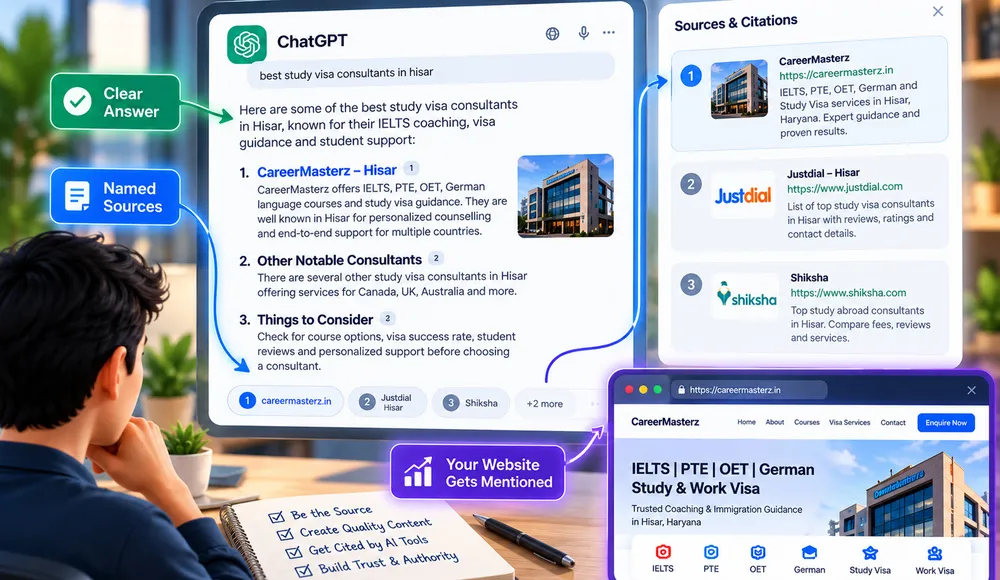
This is the most underused AEO tactic with the clearest data behind it. A 2026 study (cited in thePresenc dataset of 1,000 AI Overview samples) found that pages using named-source inline attribution — "According to a 2025 Ahrefs study, 38% of AI Overview citations come from outside the top 10" — have 2.1x higher citation odds than pages using vague attribution like "many studies show" or footnote-only references.
Why it works: language models prefer passages that already contain verifiable claims with sources. A sentence that says "according to [named source], [specific finding]" is self-validating — the AI can quote it and the claim carries built-in credibility. A sentence that says "research shows" requires the AI to add context the page did not provide.
The ~12-fact optimum: the same research found approximately 12 verifiable facts per page is the citation sweet spot. Below that, there is not enough extractable material. Beyond that, returns diminish — a page with 30 statistics does not get cited 2.5x more than one with 12. Aim for 10–15 named, verifiable facts per important page.
Named entities matter too. Citing a specific study ("BrightLocal's September 2026 study of 200,875 prompts"), a specific dataset ("Ahrefs' analysis of 1,885 pages"), or a named expert carries more weight than "industry experts believe." Every claim on your commercial pages should be attributable to something specific.
Schema Markup: What Actually Helps (and What Doesn't)
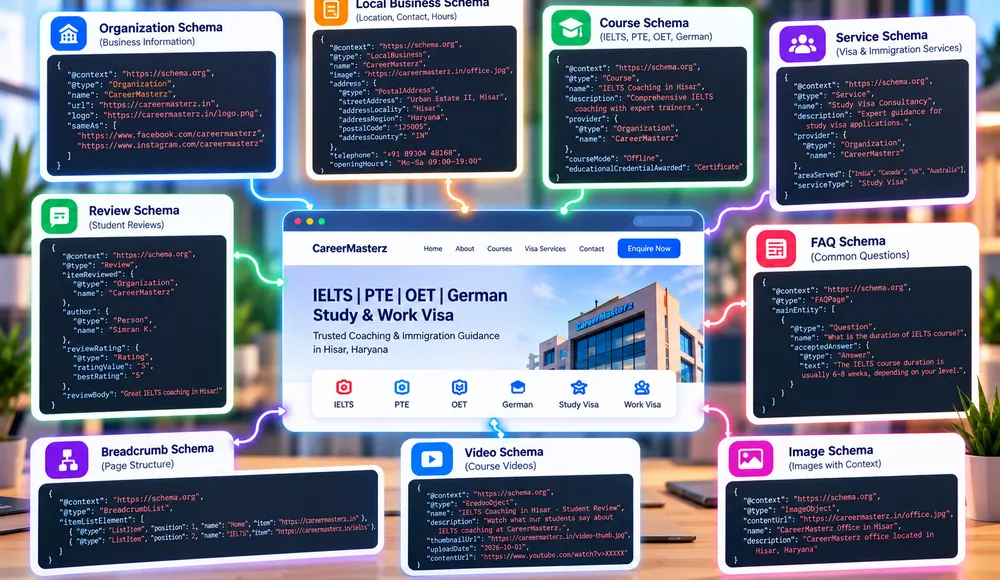
The honest answer on schema in 2026: correlational studies say schema-marked pages are cited about 2.3x more often (HowTo strongest at 2.8x, then Article at 2.3x, BreadcrumbList 1.9x, FAQPage 1.7x). But Ahrefs' causal study (May 2026, 1,885 pages adding JSON-LD vs 4,000 controls) found no citation uplift from adding schema alone — and a small negative correlation (-4.6%) in AI Overviews.
The reconciliation: schema is a proxy. Sites that implement schema thoroughly also tend to do everything else well — answer-first structure, fresh content, fast pages, strong E-E-A-T. Schema removes ambiguity for parsers; it does not buy citations on its own.
Practical stance: implement the following because they are cheap, correct, and reduce parsing ambiguity. FAQPage on any page with FAQ content. HowTo on step-by-step guides. Article on insights and blog posts. BreadcrumbList on every page. Organization + Person with sameAs links (especially author LinkedIn profiles — this strengthens E-E-A-T signals). LocalBusiness or Service with serviceArea on location pages.
Do not implement schema as a checkbox exercise. Markup that does not match visible page content is a spam signal under Google's structured data guidelines. If your page does not visibly show FAQs, do not mark up an FAQPage. If your HowTo steps are not on the page, do not mark them up. Match what users see.
Content Formats That Earn AI Citations
Presenc's analysis of 1,000 AI Overview samples found a clear format hierarchy for what gets cited.
How-to and tutorial content: 31% of citations. Step-by-step guides with numbered lists, specific instructions, and named tools. Comparisons and reviews: 24%. Side-by-side analyses with verdicts, tables, and honest trade-off discussion. Definitions and explainers: 18%. Clear "what is X" answers in the first paragraph. Original data and statistics: 12%. First-hand numbers, survey results, benchmark studies. Documentation: 8%. Technical docs, API references, implementation guides.
The pattern: formats that teach, compare, define, or present original data win. Formats that opine, speculate, or rehash existing content lose. A 2,000-word "thoughts on the future of AI" post earns zero citations. A 2,000-word teardown with named line items, real numbers, and a methodology section earns citations for years.
For a service business, the practical mix: comparison pages (your existing /compare/ section is well-positioned — add answer capsules to each), cost pages with specific numbers and line items, how-to guides for your methodology, case studies with first-hand delivery data, and FAQ blocks on every page. This mix covers the top four citation formats.
AEO for Commercial Pages (Not Just Blog Posts)
Most AEO advice targets blog content. But for a service business, the highest-leverage AEO work is on commercial pages — service pages, pricing pages, city pages, comparison pages. These are the pages that drive revenue, and 44% of AI traffic lands on bottom-of-funnel queries.
Service pages: add an answer capsule after the H1 — 40–60 words defining what the service is, who it is for, and what it costs (or the cost range). Add an FAQ section with five to six questions. Add named-source attribution for any claims ("according to [study], businesses that [do X] see [result]").
Pricing and cost pages: AI engines strongly prefer pages with specific numbers. A page that says "software development ranges from $50,000 to $180,000 depending on complexity, with EHR integration being the largest cost driver" gets cited over one that says "contact us for a quote." Your existing /pricing/ page and the cost pages we are building follow this pattern.
Comparison pages: verdict in the first 150 words, a 15–25 row table within the first 500 words, and an honest "when we are NOT the right choice" section. AI engines cite comparison content heavily (24% of all citations) and reward honesty — a page that acknowledges a competitor's advantages is more trustworthy to a language model than one that claims victory everywhere.
City pages: local queries increasingly route through AI. "Best web developer in Denver" is a ChatGPT query now. Your city pages need answer capsules, neighborhood mentions, local schema, and local proof points to be citable for these queries.
Measuring AEO: Tracking AI Referrals
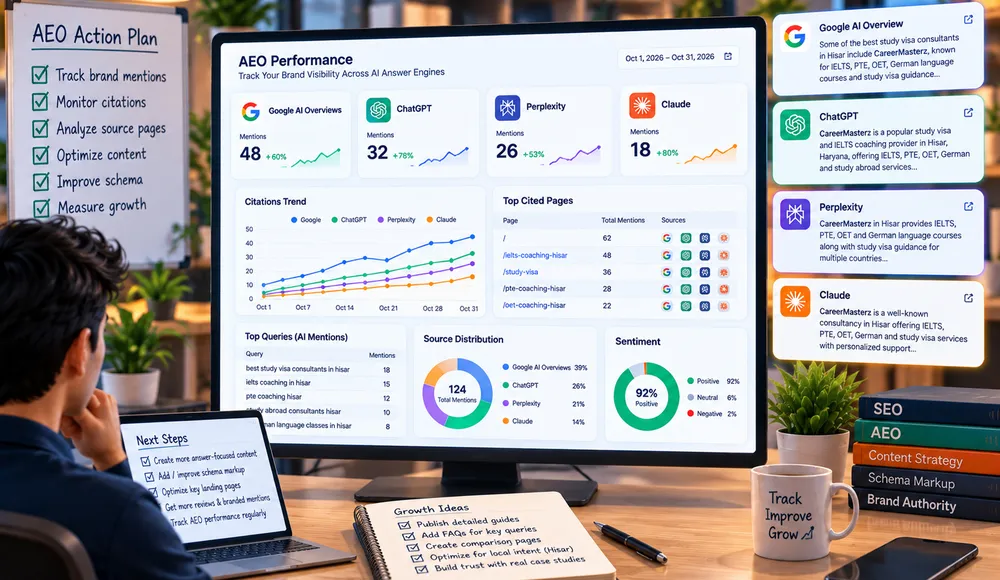
AI referral traffic is invisible in default analytics configurations. If you are not segmenting it, you cannot measure your AEO investment.
Google Analytics 4: create a custom channel group or segment for AI referrals. The referral sources to track: chat.openai.com, perplexity.ai, claude.ai, gemini.google.com, copilot.microsoft.com, and the growing list of AI crawlers that send referral traffic. Also monitor "source / medium" reports for unusual referral patterns — AI referral traffic often shows up as "referral" with a source you do not recognize.
Search Console: monitor impressions and clicks for queries that look AI-influenced — longer, conversational queries that would not have triggered traditional search. If impressions are rising on question-form queries while clicks are flat, you may be appearing in AI summaries where users get their answer without clicking. Track branded search volume as a proxy for AI mention visibility.
Manual testing: monthly, run your top twenty commercial queries in ChatGPT, Perplexity, and Google AI Mode. Document which pages get cited, what content the AI quotes, and where your competitors appear but you do not. This qualitative audit reveals content gaps no automated tool catches.
Bing Webmaster Tools: submit your sitemap and monitor indexing there. ChatGPT's web search uses Bing's index — if you are not indexed in Bing, you are invisible to ChatGPT search. This is a five-minute setup that many businesses skip.
AEO Anti-Patterns: What Gets Ignored
Hiding answers behind tabs and accordions. If your FAQ answer is injected into the DOM only on click (not present in the static HTML), AI crawlers cannot see it. Verify your accordions render answer text in the page source, not just after interaction.
Thin content with no original value. Pages that rehash existing top-ranking content without adding unique data, first-hand experience, or a new angle are not cited. AI engines already have access to the existing content — they cite pages that add something the model does not already know.
Generic headings. "Our Approach" and "Why Choose Us" do not map to any query. "How We Deliver Fixed-Scope Software in 12 Weeks" does. Every heading should be a question someone would ask an AI engine.
Missing or stale dates. AI engines prefer content with visible last-updated dates. A page with no date, or a date from 2023, reads as stale. Your git-based lastmod system already handles this — ensure the label is visible on every commercial page.
No named sources. Claims without attribution are less trustworthy to language models. "Businesses save 30% with fixed scope" is weaker than "Across our 2024–2026 engagements, fixed-scope builds finished 23% under initial estimate on average, while hourly engagements finished 41% over."
Blocking AI crawlers. Check your robots.txt. If you are blocking GPTBot, ClaudeBot, or PerplexityBot, you cannot be cited. Most businesses block these inadvertently through broad disallow rules. Allow AI crawlers — they are a discovery channel, not a threat.
Action Framework
Ship-It Checklist
- Answer capsule (40–60 words) added after H1 on every service, pricing, comparison, and city page.
- Every H2/H3 reviewed: does it map to a question someone would ask an AI engine?
- Each section's first paragraph restructured to lead with the conclusion (inverted pyramid).
- Named-source inline attribution added for at least 10 verifiable claims per key page.
- FAQPage schema implemented and matching visible FAQ content on every page with FAQs.
- Article schema on all insight pages; Organization + Person with sameAs on author bios.
- LocalBusiness or Service + serviceArea schema on all location pages.
- robots.txt reviewed: GPTBot, ClaudeBot, PerplexityBot not blocked.
- Sitemap submitted to Bing Webmaster Tools (ChatGPT uses Bing's index).
- AI referral segment set up in analytics (chat.openai.com, perplexity.ai, claude.ai, gemini.google.com).
- Monthly manual citation audit scheduled: top 20 commercial queries in ChatGPT, Perplexity, AI Mode.
- Content mix shifted toward citation-winning formats: comparisons, how-tos, definitions, original data.
- No answers hidden behind JavaScript-only accordions — all FAQ answers present in static HTML.
- Lastmod date visible on every commercial page.
FAQ & Decision Rules
Frequently Asked Questions
What is Answer Engine Optimization (AEO)?
Answer Engine Optimization is the practice of structuring web content so AI search engines — ChatGPT, Perplexity, Google AI Overviews, Gemini — cite it directly in their synthesized answers. It overlaps with traditional SEO but emphasizes answer-first page structure, self-contained extractable passages, named-source attribution, and schema markup that reduces parsing ambiguity.
Is AEO replacing SEO?
No. AEO is a layer on top of SEO. Ahrefs' 2026 data found 76% of AI Overview citations come from pages already ranking in the top 10 — traditional rankings still matter. But 46% of cited URLs rank outside the top 5, meaning well-structured niche content can earn citations without a number-one ranking. The two disciplines are complementary, not competitive.
What is the single most effective AEO tactic?
Answer-first page structure: placing a 40–60 word direct answer immediately after each H2 or H3. AI engines extract self-contained passages, not full articles. Pages that lead each section with the conclusion are cited significantly more than pages that bury the answer in paragraph three. This is the highest-leverage change with the lowest implementation cost.
Does schema markup help with AI citations?
Correlational studies show schema-marked pages are cited about 2.3x more often, but Ahrefs' May 2026 causal study found no citation uplift from adding schema alone. Schema removes ambiguity for parsers and is a correctness baseline — implement FAQPage, HowTo, Article, BreadcrumbList, and Organization schema where they genuinely match visible content. But do not expect schema alone to move the needle.
How many facts or statistics should a page have for AEO?
Approximately 12 verifiable facts per page is the citation optimum, based on a study of 57,253 URLs (Presenc, April 2026). Below that, there is not enough extractable material. Beyond that, returns diminish. Combine this with named-source inline attribution — "According to [Source], [finding]" — which increases citation odds by 2.1x.
How do I track if my AEO efforts are working?
Three methods: set up AI referral traffic segments in analytics (chat.openai.com, perplexity.ai, claude.ai, gemini.google.com), monitor Search Console for rising impressions on conversational question-form queries, and run a monthly manual audit of your top twenty commercial queries in ChatGPT, Perplexity, and Google AI Mode, documenting which pages get cited. Also submit your sitemap to Bing Webmaster Tools since ChatGPT uses Bing's index.
Sources
- Google - Optimizing for generative AI features
- Google - Using generative AI content
- Google - Creating helpful, people-first content
Google states that AEO and GEO are still SEO, that llms.txt is ignored, and that special schema and content chunking are not required. The capsule and table findings come from published research on AI citation patterns, not from Google.
Written by Rohan Verma • Frontend Engineer
Ships the interface clients touch daily — fast, accessible, maintainable — and owns the site's rendering, performance and structured-data layer.
Technical SEO ArchitectureCore Web VitalsStructured Data & SchemaAnswer Engine Visibility
Published on 2026-10-10. Last updated 2026-10-22.
Reviewed for technical accuracy by Shruti Mehta, Founder.
For clarifications or corrections, email contact@anyplacehub.com.
Figures and illustrations on this page: illustrations are AI-generated, not photographs or client screenshots. Statistics are either linked to a published source or labelled in the text as a rule of thumb from our delivery work. See the editorial policy.