
- The only distinction that matters: Google Ads captures demand that already exists, Meta Ads creates demand that doesn't exist yet. Match the platform to whether your customers are already searching for you.
- Cheaper clicks are not cheaper customers — Meta clicks cost less but convert at a lower rate, while Google's expensive clicks arrive with purchase intent. Judge both platforms on cost per qualified lead, never cost per click.
- Budget splits are a framework, not a religion: local service businesses typically start 80% Google / 20% Meta, new brands with no search demand 80% Meta / 20% Google, ecommerce roughly 60% Meta / 40% Google.
- Landing page quality and conversion tracking decide the winner more than the platform does — a mismatched page and untracked conversions make both channels look equally bad.
- Run both channels small and parallel for 2–4 weeks, compare cost per qualified lead, then reallocate. The first month is a measurement exercise, not a scale decision.
Most first ad budgets die the same death: a business picks a platform because a cousin swore by it, hands over a month's budget, sees a pile of cheap clicks or a trickle of expensive ones, and concludes 'ads don't work'. The platform rarely deserves that verdict. The choice — and the tracking around it — usually does.
Google Ads and Meta Ads are not competitors offering the same product at different prices. They sit at opposite ends of customer demand. Google captures people who are already typing your service into a search box; Meta reaches people who aren't looking yet, showing them an offer they didn't know they wanted. Confusing the two is how budgets get misallocated in the very first month.
This guide breaks the decision into pieces you can actually use: what the benchmarks say about cost and conversion, what ads cost by business type (with Indian rupee ranges alongside dollar figures), a decision framework keyed to your business model, a budget-split starting point for each scenario, the landing page and tracking prerequisites both channels need, the six patterns that leak first budgets, and a 30-day launch plan that treats month one as research. If you'd rather have a team run the whole thing fixed-scope, our digital marketing services page shows how campaigns are structured, priced and reported — and pricing shows the shapes involved.
Worth saying plainly before the benchmarks: most businesses that do this well end up running both channels, not choosing a permanent winner. The question is not 'Google or Meta forever' but 'which one earns the next rupee of budget this month'. Treating the choice as a tribal identity — a stance many agencies perform on social media — is how budgets get locked into whichever platform the loudest person in the room happens to like.
The short version: choose the platform that matches whether your customers are already searching. Everything else — CPC, creative format, budget split — is downstream of that one question.
1. Demand capture vs demand creation: the only distinction that matters
Someone with a leaking roof searches 'roof repair near me' at 9pm. That query is demand arriving at full strength — the decision is already made, only the vendor is undecided. Google Ads exists to intercept exactly that moment. You pay for the click, but the click comes pre-qualified: the person raised their hand first.
Meta Ads works earlier in the journey. A homeowner scrolling through Instagram isn't thinking about their roof. An ad — a before-and-after photo, a seasonal offer, a short video of a repair job — plants the thought, earns attention, and often starts a search that Google will later capture. The lead was created on Meta and closed somewhere else, which is exactly why attribution between the two channels gets messy.
This asymmetry explains nearly every benchmark you'll read. Google clicks cost more (search CPCs commonly land between ₹10 and ₹100 in India, higher in legal, finance and real estate) because the traffic is people in buying mode. Meta clicks cost less (often ₹5–₹30) because most impressions are people in browsing mode. Neither number is 'better' — they measure different moments.
The practical test for any business: when your ideal customer realises they need you, do they go to a search box? Plumbers, clinics, lawyers, accountants, 'service near me' queries — yes, overwhelmingly. Fashion, food, apps, novel products, anything people don't know to look for — less so. Start from that answer, not from the platform's marketing.
There is a second-order effect worth naming: Meta advertising frequently creates the searches Google later captures. A homeowner who sees three roof-repair ads this week may search the company name next week — and the brand search that results is credited to Google in your reports while Meta gets nothing. Channel reports claim last touch; customers experience one journey. Read your dashboards with that translation layer always switched on.
2. What the benchmarks actually say about cost
Across published industry studies, Google Search averages roughly $2.50–$2.70 per click and Meta roughly $0.50–$0.60 — but the more useful numbers sit further down the funnel. Google search ads commonly convert around 3.5–4.5% of clicks into actions; Meta campaigns more often land between 1.5% and 2% on comparable conversion events. Cheap traffic at a third of the conversion rate is not automatically cheaper customers.
Cost per lead is the number where the gap becomes uncomfortable. Aggregated benchmarks put Google's average cost per lead meaningfully higher than Meta's — often cited around three Meta leads for the price of one Google lead. That sounds like a Meta win until you sit in the follow-up queue: search leads arrive further down the funnel, having already compared options, and typically close at higher rates. A 'lead' is only as valuable as its closing probability.
On return, both platforms converge more than fan-well charts suggest. Well-run Meta campaigns commonly report return on ad spend between 3:1 and 5:1; Google's median across industries sits around 3.5:1. The spread inside each platform — driven by offer, tracking and landing page — dwarfs the spread between platforms. Optimisation quality is the variable, not the channel.
Read all benchmarks as weather reports, not promises. Indian CPCs run well below US or UK levels — Google Search in India commonly spans ₹10–₹100 across mainstream industries, with real estate, insurance and legal pushing far higher — but so do expectations for lead volume. The only number that will ever be yours is your own cost per qualified lead, measured in your own CRM, after your own follow-up. All figures here are illustrative planning ranges, not quotes.
One trap inside benchmark-chasing: platforms optimise toward whatever you tell them to count. Tell Meta to minimise cost per link click and it will find every clicker in your audience — including the ones who will never buy. Tell Google to maximise conversions without a value attached and it will find the cheapest conversions, not the most valuable. Benchmarks describe other people's answers; your conversion definition decides whether your numbers mean anything at all.

3. What ads cost by business type
Budgets below are starting shapes from agency and platform guidance for the Indian market, not floors. A local salon can generate real signal at ₹15,000–₹30,000 a month; a coaching institute typically needs ₹30,000–₹80,000 to feed admissions pipelines; real estate and finance campaigns routinely run into six figures because CPCs of ₹50–₹500 consume budget before the second week ends.
By industry, typical Google Search CPC ranges look like this: restaurants and food ₹5–₹25, home services ₹10–₹50, education and coaching ₹15–₹80, healthcare and clinics ₹20–₹100, B2B services ₹30–₹150, digital marketing itself ₹40–₹200, real estate ₹50–₹200, and legal or insurance ₹80–₹500. Meta undercuts most of these ranges, but impression volume — not click intent — is what you're buying there.
Lead volume math is brutally simple and worth doing before spending anything: budget divided by CPC gives clicks; clicks times conversion rate gives leads; leads times your close rate gives customers. If ₹25,000 buys clicks at ₹40 and your landing page converts 6% of them, that's roughly 625 clicks and about 37 leads — before your team's follow-up speed and close rate take their cut. Run the arithmetic for both platforms with honest numbers and the 'which is cheaper' debate usually resolves itself.
Watch the compounding factors: tier-one cities run roughly 1.5× the CPCs of tier-two locations; seasonal competition spikes (admissions season, festive retail, tax deadlines) move CPCs inside a single quarter; and quality score — Google's relevance rating — can shift your actual CPC by 20–30% without any change in bid. Cost is a managed variable, not a fixed tariff.
Two budgeting mechanics complete the picture. First, daily budgets: platforms may spend up to twice your daily average on strong days and less on weak ones, so judge spend over weeks, not mornings — a slow Tuesday afternoon means nothing. Second, impression share: if your Google campaigns show high impression share and cheap clicks but tiny volume, you've already won the available demand and growth must come from new keywords, new geos or a second channel — not from bidding harder on the same ten queries.
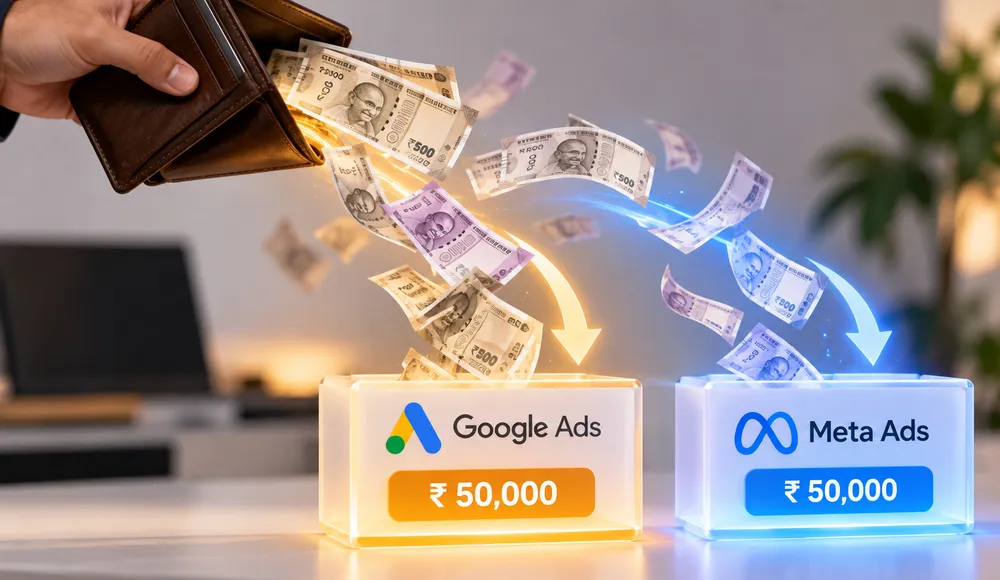
4. Which platform fits your business: a decision framework
Local service businesses — clinics, contractors, salons, repair services, tutors — should almost always start on Google. When the need hits, customers search immediately and act immediately; a well-built search campaign with call extensions and a fast landing page turns intent into phone calls within days. Meta stays in the mix at a supporting budget for seasonal offers, retargeting site visitors, and staying visible between searches.
New consumer brands — fashion, food, apps, décor, anything with visual appeal and no existing search demand — should start on Meta. You cannot capture demand that hasn't been created; Meta's job is to generate the curiosity that later becomes branded search. Layer Google in once branded impressions appear, to defend your own name and catch the demand Meta created.
Ecommerce with visual products splits across both: Meta for discovery, carousels and retargeting of product viewers; Google Shopping and search for people actively comparing and buying. B2B services lean Google for bottom-funnel intent, with LinkedIn or Meta nurturing the longer evaluation cycle. Established brands with steady search volume typically run Google-led with Meta as the always-on awareness and remarketing layer.
One caveat on lead quality: Meta lead forms produce volume cheaply, and cheap volume is seductive. If your team can't respond to every lead within an hour, Google's smaller, higher-intent flow will outperform it — speed to lead matters more than lead count in almost every service business we've scoped. Pick the platform your operation can actually service.
Revisit the decision when the business changes rather than when the platform's brand does: a new city with different search behaviour, a product line nobody searches for yet, a seasonal push with an offer built for feeds — each is a reason to re-weight the split. The framework is a starting prior, not an identity; businesses grow by moving budgets as their own demand curve moves, and the ones that treat a platform choice as permanent are usually paying for someone else's certainty.

5. Budget splits: a framework, not a religion
Commonly recommended starting splits by scenario: local service businesses (search demand exists and is urgent) around 80% Google / 20% Meta; new brands with zero search demand around 80% Meta / 20% Google; established brands with steady search volume around 60% Google / 40% Meta; ecommerce with strong visual products around 60% Meta / 40% Google. These are priors to start from, not verdicts — your account data should overrule them by week three.
Whatever the split, ring-fence a testing slice — roughly 10–20% of budget — for experimentation: new creative, new audiences, one new campaign type. Channels decay without fresh creative; a portfolio that only runs winners eventually runs out of them. The testing slice is what keeps next quarter's numbers from being a slow decline.
Split budget by objective, not by habit. If this quarter's goal is pipeline, weight the channel producing qualified conversations; if it's a product launch in a category nobody searches for, weight creation. Revisit the split on a fixed monthly date with one question: cost per qualified lead, by channel, over the last 30 days. Opinions lose to that table.
Warn against two failure modes. First, splitting so thin that neither platform exits its learning phase — most campaigns need a conversion-per-week threshold before automated bidding stabilises, and a ₹5,000 slice across four campaigns never reaches it. Second, 'testing' both platforms sequentially over six months, which confounds seasonality with platform performance. Run both small and parallel, then reallocate.
When the data conflicts with the framework, follow the data — but verify the data first. A channel that suddenly halves its cost per lead may have changed the lead definition (a new shorter form counting 'leads' the old form filtered out), or lead quality may have dropped so far that sales stopped logging dispositions. Before rebalancing a budget, confirm that both columns of the comparison still mean the same thing. Half of all budget reversals that get reversed again trace back to a measurement change nobody noticed.
6. Landing pages and tracking decide who wins
Both platforms are delivery systems; your landing page is where money is actually made. The page must match the ad's promise exactly — same offer, same wording, same intent — and load fast on mobile, because that's where most Indian traffic lands. A slow, generic homepage as a destination is the single most common way a healthy ad budget produces nothing.
Conversion tracking must be wired before the first campaign: page view, form submit, phone click, WhatsApp click, purchase — sent back to Google Ads and Meta as conversion events with values where they exist. Without this, both platforms' algorithms optimise toward the wrong proxy (clicks or cheap form fills) and your reporting measures noise. One source of truth — GA4 or your CRM — reconciles the two channels.
Lead response speed deserves its own paragraph: leads contacted within an hour convert multiple times better than leads contacted hours later. Routing form submissions to a person — not a spreadsheet — is a paid-media decision even though it looks like a sales-process decision. Campaigns get blamed for pipeline gaps that were actually response-time gaps.
Finally, keep ad accounts, domains and pixels in your own business's ownership from day one. Agency-managed assets that can't be transferred are a hostage situation disguised as a service. It's the same fixed-scope principle we apply to builds — see fixed-scope vs hourly — applied to media buying.
Treat creative as infrastructure, not decoration: build a simple asset library — one clear offer statement, three proof points, a set of real photos or short videos, and landing-page copy that mirrors the ad promise. When creative fatigues at week four (it will), the next variation comes from the library in an afternoon instead of a two-week scramble. Businesses that win paid media are rarely the ones with the cleverest single ad; they're the ones who can produce the tenth ad as calmly as the first.
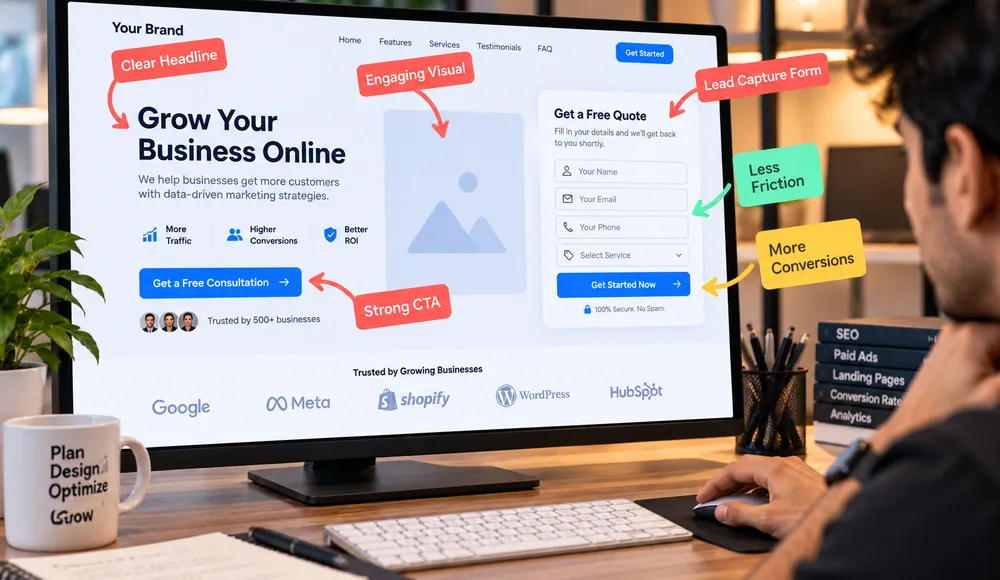
7. Where first budgets leak: six waste patterns
Pattern one — broad match without negatives on Google: keywords like 'plumber' pull in job seekers, DIY researchers and unrelated queries, and automated bidding happily buys them. Start with phrase and exact match, then mine the search terms report weekly and add negatives. Pattern two — boosting posts instead of running conversion campaigns on Meta: engagement optimisation buys likes; conversion optimisation buys leads. Choose the objective deliberately.
Pattern three — no retargeting: most visitors won't convert on first contact, and retargeting is the cheapest lead either platform produces. A basic site-visitor audience plus a product-view audience is the minimum viable retargeting setup. Pattern four — one creative, forever: creative fatigue is real and fast; rotate variations of hook, format and offer instead of waiting for performance to collapse.
Pattern five — optimising to the cheaper metric: choosing the channel with lower CPC when the goal is customers. Judge on cost per qualified lead and cost per sale; CPC is a diagnostic, not an objective. Pattern six — no budget pacing: setting a daily budget and never checking mid-month means a losing campaign can consume a third of the month before anyone notices. Weekly pacing reviews are non-negotiable in the first 90 days.
Each leak has the same shape: the platform happily spends money that isn't producing business, because nobody wired the feedback loop. Budget discipline is not a finance task — it's the core operating rhythm of paid media.
A pacing rhythm that catches all six looks like this: Monday, five minutes per platform — spend vs plan, cost per qualified lead, anything obviously broken; Wednesday, the search-terms report on Google and creative fatigue on Meta; monthly, a single review table with both channels side by side and one decision written at the bottom. Total time: under an hour a week. Budgets without this rhythm don't fail loudly — they drift, then die in a quarterly reconciliation nobody prepared for.
One final discipline ties the rhythm together: change one variable at a time. Swap the headline and the audience together and you'll learn nothing when results move — you won't know which change did it. Campaigns that improve steadily are almost always campaigns where someone kept a dated changelog — hypothesis, change, date, result — and let each test finish before starting the next. It is unglamorous bookkeeping, and it is the difference between optimising and guessing in expensive clothes.

8. A 30-day launch plan for your first ad budget
Days 1–7 — foundations: confirm the offer and its economics (what a lead is worth, what you can afford to pay for one), build or fix the landing page, wire conversion events end to end, and set up call and WhatsApp tracking. Create accounts in your own business name. No spend until tracking reports a test conversion.
Days 8–14 — launch both channels small: on Google, ten to twenty tight intent keywords with phrase/exact match, ad groups grouped tightly by intent, call extensions and location assets; on Meta, one conversion campaign with two or three creative variations and a retargeting audience seeded from site visitors. Equal small budgets so both produce comparable data.
Days 15–21 — read and prune: search terms report on Google (negatives, wasted queries), creative fatigue and audience overlap on Meta, and the first cost-per-qualified-lead readings from your CRM — not from the platform dashboards, which count form fills your team never called back. Kill anything clearly broken; resist killing anything merely slow.
Days 22–30 — reallocate and set the cadence: move budget toward the channel producing qualified conversations at acceptable cost, keep the testing slice alive, and install the operating rhythm — weekly pacing and negatives, mid-month creative refresh, monthly cost-per-qualified-lead review with one change per losing channel. Month one's deliverable is a measured decision, not a scaling story. When that decision needs a team to execute, our campaign management process runs exactly this cadence, fixed-scope.

9. The one-page monthly report that keeps budgets honest
After launch, reporting is what separates businesses that scale ad spend from businesses that scale ad spend and regret it. The report is one page and never changes format: by channel — spend, clicks, conversions, cost per conversion, cost per qualified lead, qualified leads, sales started, sales closed; then one line of context (what changed on the account, what changed in the market); then the single decision for next month. Six numbers per channel, one decision, no slide theatre.
Qualified lead is the load-bearing term, and it must be defined in writing with sales: what counts (form plus reachable human, phone answered, budget present, need real), what gets excluded (job seekers, competitors, wrong geography, no response after two attempts). Both channels get judged only on leads meeting that definition. This is where most agency reporting quietly diverges from business reality — platform dashboards count submissions, your report counts conversations.
Include trend direction rather than single-month absolutes: cost per qualified lead up or down over the trailing three months, and whether the testing slice produced anything worth promoting. One month is weather; three months is climate. Reallocate on climate — moving the entire budget on a single strong or weak week is how accounts get stuck in permanent restart mode.
End every report with what you will change, not what you observed. 'Meta cost per lead rose' is an observation; 'Meta gets 20% less budget until we rotate three new creatives and re-test the offer' is a decision. Businesses that keep this page for six months accumulate something more valuable than any single campaign result: a written history of what they tried, what happened, and why the budget sits where it sits.
Action Framework
Ship-It Checklist
- Lead value and target cost per lead written down before any spend
- Landing page matches ad promise, loads fast on mobile, one clear action
- Conversion events (form, call, WhatsApp, purchase) verified in Google Ads and Meta
- Ad accounts, domain and pixels owned by your business — not the agency
- Google: phrase/exact keywords only, tightly grouped by intent, negatives list started
- Meta: conversion objective (not post boosts), 2–3 creative variations live
- Both channels launched small and parallel — no sequential six-month 'tests'
- Retargeting audiences seeded from site visitors on both platforms
- Speed-to-lead routing live: every lead reaches a person within the hour
- Weekly review installed: search-term negatives, creative fatigue, budget pacing
- Monthly reallocation rule: move budget by cost per qualified lead, not CPC
FAQ & Decision Rules
Frequently Asked Questions
Which is better for small business: Google Ads or Meta Ads?
For local service businesses whose customers search when needed — clinics, contractors, salons, tutors — Google Ads usually produces better leads first. For new consumer brands with no existing search demand, Meta creates the awareness Google later captures. Most businesses end up running both with different roles.
Are Meta ads cheaper than Google ads?
Cost per click, yes, usually — often a third of Google's CPC. Cost per customer is the real question: Meta's cheaper clicks convert at lower rates and often need more follow-up, so compare both platforms on cost per qualified lead from your CRM, not on CPC from the platform dashboards.
How much should I budget to start advertising?
In India, meaningful local campaigns commonly start around ₹15,000–₹30,000 per month per channel; competitive verticals need more because CPCs are higher. The practical floor is the spend that produces roughly 30–50 conversions a month — below that, algorithms can't learn and your data stays noise.
How long until ads produce results?
Search campaigns can generate calls within days of launch; Meta typically needs one to two weeks of learning before delivery stabilises. The first month is measurement — expect to reallocate budget by week four based on cost per qualified lead, not to have scaled anything yet.
Should I run both platforms at once?
Yes — run both small and parallel for the first two to four weeks so seasonality doesn't masquerade as platform performance. Sequential testing over months confounds everything. Compare cost per qualified lead after a few weeks, then reallocate toward the winner while keeping a small testing slice on the other.
Can I run ads without a big budget?
You can validate cheaply: one tight campaign, one landing page, one clear offer, strict negatives and daily pacing. What doesn't work is spreading a small budget so thin that neither platform's algorithm exits its learning phase. Concentrate, measure, then expand.
What is the most common reason first ad budgets fail?
Missing conversion tracking and a mismatched landing page — money gets spent, clicks arrive, and nobody can prove which spend produced business. Fix tracking and landing page alignment before increasing budget; then audit for the six waste patterns: broad match without negatives, post boosting instead of conversion campaigns, no retargeting, stale creative, optimising to CPC instead of qualified leads, and no budget pacing.
Written by Shruti Mehta • Founder & Principal Technology Strategist
Founder of AnyPlace. Oversees commercial architecture, fixed-scope delivery governance, and client engineering partnerships across global markets.
Fixed-Scope ArchitectureTechnology StrategyDelivery Governance
Published on 2026-09-25. Last updated 2026-09-25.
Reviewed for technical accuracy by Shruti Mehta, Founder.
For clarifications or corrections, email contact@anyplacehub.com.